Author: Tarunabh Dutta

  • Who Wrote the Bhagavad Gita? Vyasa, Ganesha and the Text

    Who Wrote the Bhagavad Gita? Vyasa, Ganesha and the Text

    The Bhagavad Gita was composed by the sage Ved Vyasa as part of the Mahabharata, the epic he is credited with authoring. Its words are the teaching of Lord Krishna to the warrior Arjuna on the battlefield of Kurukshetra. According to tradition, Lord Ganesha wrote the Mahabharata down as Vyasa dictated it.

    So the Gita has three “authors”, each in a different sense: Krishna, who spoke it; Vyasa, who composed the epic that holds it; and Ganesha, who, in the famous story, wrote it down. Here is how the three fit together, and what scholars say about when the text took shape.

    Watch: the life of the one who spoke the Gita: Shri Krishna’s Entire Life in a Captivating Animated Song, by TD Film Studio.

    Krishna speaking to Arjuna on the chariot at Kurukshetra at dawn, the Bhagavad Gita scene recorded in the Mahabharata
    Image generated with AI for TD Film Studio.

    Krishna spoke it, Arjuna heard it

    The Bhagavad Gita, “the Song of the Lord”, is a conversation. On the morning of the great war, Arjuna sees his teachers, cousins and elders lined up against him and lays down his bow, unable to fight. Krishna, serving as his charioteer, answers his despair. Over 18 chapters he speaks of duty (dharma), action without attachment to its fruits (karma yoga), knowledge (jnana) and devotion (bhakti). He ends by revealing his universal form.

    In this sense the teaching is Krishna’s. Devotees regard the Gita as the direct word of God, which is why it is often called the essence of the Vedas.

    Vyasa composed the Mahabharata that holds the Gita

    The Gita is not a separate book in its origin. It forms chapters 23 to 40 of the Bhishma Parva, the sixth of the Mahabharata’s eighteen books (in the Critical Edition). Tradition names the sage Krishna Dvaipayana Vyasa as the composer of the whole epic, and so of the Gita within it.

    Vyasa is also a character in his own story: the grandfather of both the Pandavas and the Kauravas, and the sage credited with arranging the Vedas. In the epic, Vyasa gives the charioteer Sanjaya divine sight so that he can see the distant battlefield and narrate the war, and the Gita, to the blind king Dhritarashtra. That is why the Gita opens with Dhritarashtra asking Sanjaya, “What did my sons and the sons of Pandu do, gathered at Kurukshetra?”

    Ganesha wrote it down

    The most loved part of the story comes from a passage in the Mahabharata’s first book, the Adi Parva, found in many versions of the epic. Vyasa needed a scribe who could keep pace with his composition, and he asked Ganesha. Ganesha agreed on one condition: Vyasa must dictate without ever pausing. Vyasa agreed with a condition of his own: Ganesha must understand every verse before writing it.

    Whenever Vyasa needed time to compose, he spoke a verse so complex that Ganesha had to stop and think. In some tellings, when his pen broke, Ganesha snapped off one of his own tusks and kept writing. That is why he is often shown with a broken tusk.

    How many verses and chapters are in the Bhagavad Gita?

    The Gita has 18 chapters and 700 verses (shlokas) in its standard form. Most verses are in the anushtubh metre, the same metre as most of the Mahabharata.

    When was the Bhagavad Gita written?

    There are two answers, and both are worth knowing.

    • Tradition places the Kurukshetra war at the end of the Dvapara Yuga. The beginning of the Kali Yuga is traditionally reckoned at 3102 BCE.
    • Scholars date the composition of the Gita as we have it to roughly the 2nd century BCE to the 2nd century CE, as part of the long growth of the Mahabharata, which drew on much older oral tradition.

    The Gita’s influence needs no date: it has been commented on by Adi Shankaracharya, Ramanujacharya and Madhvacharya, translated into English by Charles Wilkins in 1785, and read by thinkers from Mahatma Gandhi to Henry David Thoreau.


    Watch Krishna’s story

    TD Film Studio tells India’s sacred stories as animated cinema. Shri Krishna’s Entire Life in a Captivating Animated Song has been watched more than 1.5 million times, and Radha Krishna: The Ultimate Divine Love Story tells their love as a cinematic short.

    Frequently asked questions

    Who is the author of the Bhagavad Gita?

    The sage Ved Vyasa is credited with composing it as part of the Mahabharata. The teaching itself is spoken by Lord Krishna to Arjuna, and tradition says Lord Ganesha wrote the epic down as Vyasa dictated.

    Did Krishna write the Bhagavad Gita?

    Krishna spoke the teaching; he did not write it down. It was composed in verse by Vyasa within the Mahabharata and narrated in the epic by Sanjaya.

    Which part of the Mahabharata is the Bhagavad Gita?

    It is in the Bhishma Parva, the sixth book of the Mahabharata: chapters 23 to 40 in the Critical Edition.

    How many shlokas are in the Bhagavad Gita?

    Seven hundred, across 18 chapters.


    Sources: the Mahabharata, Bhishma Parva and Adi Parva (Critical Edition, Bhandarkar Oriental Research Institute); Bhagavad Gita on Wikipedia; Encyclopaedia Britannica, “Bhagavadgita”.
  • Making of Radha Krishna: The Animation Process, Decision by Decision

    Making of Radha Krishna: The Animation Process, Decision by Decision

    This is the making of Radha Krishna, a twenty-one-minute animated film, told by the person who directed it: the research, the song, the faces, the storyboard and the animation process, decision by decision. Every number comes from the production’s own records. Watch the full film here, and read its story on the Radha Krishna film page.

    I am Tarunabh Dutta. I wrote this film and I was its animation director, at TD Film Studio in Guwahati. I made it over six months, between July 2025 and January 2026. Behind its twenty-one minutes are 2,902 storyboard frames, 249 character images and 848 animated clips.

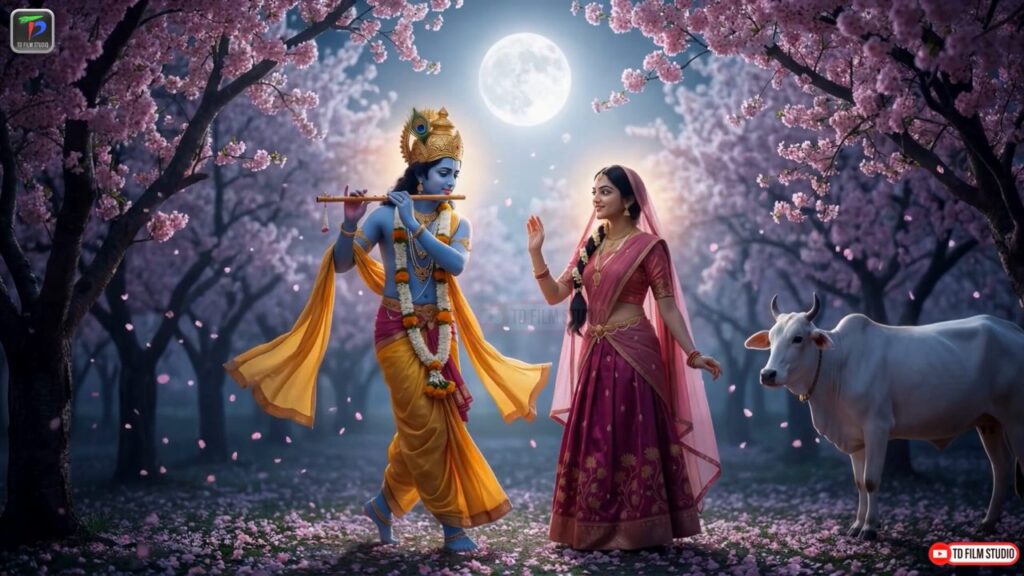
    Making of Radha Krishna: Krishna playing the flute to Radha in a moonlit blossom grove, a frame from the animated film
    From Radha Krishna, 12:20.

    Can AI make a real film?

    In twenty years of filmmaking, from live action to animation, a tool has given me clips, never a film. AI animation tools are not built to tell stories. A clip does not know what came before it or what must come after. Structure, continuity, performance and rhythm have to come from a filmmaker. If you put generated clips side by side, you get a slideshow. If you direct them, you get cinema.

    Why did Krishna not marry Radha? The research behind the story

    Everyone asks why Krishna did not marry Radha, and why he left Vrindavan and never returned, so I made the film answer it. With my assistant director and researcher, Himakhi Dutta, I went to the scripture first: the Bhagavata Purana, Book 10, for Akrura’s summons and the Raas on the autumn full moon; the Brahma Vaivarta Purana, where Radha is Krishna’s own other half and Goloka is where they are one; and the Mahabharata, for the duty Krishna left Vrindavan to serve.

    My answer became the spine of the film: Krishna did not leave Radha. He left his own happiness, so that the world would always say her name first. I also made one creative choice of my own. In the Bhagavata it is Yashoda who sees the cosmos in Krishna’s mouth; in my film, it is Radha.

    The animation process, stage by stage

    The song came first

    I wrote the song “Radhe Shyam” in July 2025, five months before the first frame. One line, ek praan do kaaya, one soul in two bodies, became the whole film. I made thirteen versions of the song before I chose one, and when the picture grew, I extended the music six times to fit it.

    Why I removed the narrator

    My first draft had a narrator: the poet-saint Meera, watching the love story from outside. I designed her, and then I removed her completely. I wanted you to stand where a devotee stands, with nothing between you and Radha.

    Fifty intimate moments, and the thorn

    Then I wrote fifty small, intimate moments: a footprint, a thorn, a turmeric-stained palm, a yellow cloth in the rain. In my first draft, Radha pressed her arm into the thorns that had cut Krishna. I rewrote it: now she is hurt, and he feels the pain. The bond carries it, not her choice. The story filled 1,045 pages of notes before I wrote the screenplay.

    Casting Radha’s face before her costume

    In the first two days I rejected the glossy calendar-painting look. I cast Radha’s face first: an ordinary young woman, no jewellery, no make-up. Divinity would come only from costume and light. I made 249 character images, locked both faces in three days, and then dressed the same face for every scene. For the farewell I chose black and gold, so her grief would read before a word was spoken.

    Storyboard to animation

    Krishna presses a red dot onto Radha’s turmeric palm and kisses it. I locked that close-up on my first board on 28 November and carried it unchanged to the final film. Other boards I redrew: on 23 December I recomposed the farewell so that Radha kneels with folded hands, not a lover begging but a devotee letting go. I drew 2,902 storyboard frames, and boarded the Maha Raas three times before it felt like a dance of the soul.

    What does an animation director do with 848 clips?

    Every approved still became the first frame of a moving shot: the river farewell, the tear, the Raas seen from the sky. I directed 848 animated clips, seventy-nine minutes in all, for a film of twenty-one. For every second you see, I made almost four, and kept only what held the story.

    The blossom-orchard dance went through three passes. I rejected seven takes of it on a dark stage, moved it to an orchard under the full moon, and re-mastered it again six months after release. That is the work of an animation director on an AI-assisted film: not making shots, but choosing, rejecting and holding the line.

    The edit, and my one regret

    The film began as a music video of about eight and a half minutes and became a film of twenty-one. In the last four days I added the epilogue that answers why Krishna never returned. My one regret is the opening: my hook grew from one minute to nearly four, so Radha’s story begins at 4:04, and many viewers leave before she arrives. If you left early, start the film at 4:04.

    Divine, and deeply human

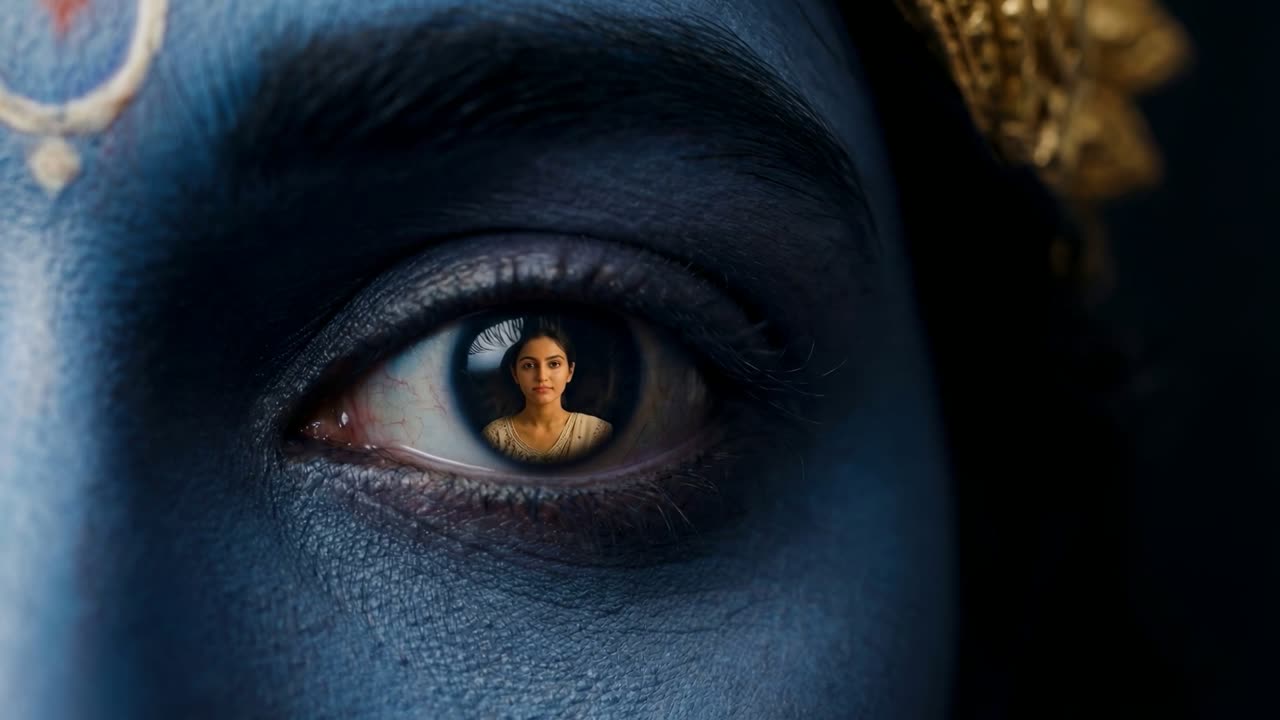
    What I would not compromise on: Radha and Krishna as divine, and still deeply human. Tears with kajal in them. Each living in the other’s eye: look at 10:03, and in Krishna’s eye you see Radha; in hers, you see him. Separation shown not as abandonment, but as love’s deepest form. That single frame is the whole film.

    More films, taken apart

    Every film has its own page on our films page, and the devotional films are together under Hindu mythology animated films. The same method, on other stories:

    Commission a film from an animation studio in India

    TD Film Studio is an animation studio in Guwahati, Assam. We make devotional, epic and story-driven animated films, music videos and commercials, AI-assisted, on a workflow built in-house over twenty years of filmmaking. Research, song, story, design, animation, edit and sound stay under one direction, so nothing is lost between departments. See our animated video production service, or tell us your story.

    Frequently asked questions

    Can AI make a movie?

    It can make clips, not a film. A clip does not know what came before it or what must come after. Structure, continuity, performance and rhythm come from a director; Radha Krishna is AI-assisted animation, and every one of those decisions was made by hand.

    What is the animation process for a film like this?

    Research, the song, the story and screenplay, character design, the storyboard, animation, the edit and the sound, in that order. For Radha Krishna that meant 2,902 storyboard frames, 249 character images and 848 animated clips for a twenty-one-minute film.

    What does an animation director do on an AI-assisted film?

    Decides everything the tools cannot: what the story means, what each face and costume must say, which board becomes a shot, which of many takes holds the story, and where every cut falls. On this film I kept roughly one second of animation for every four I made.

    How long did Radha Krishna take to make?

    About six months, from the first song file in July 2025 to release in January 2026, with the main production in the last eight weeks.

    Can TD Film Studio make a devotional animated film for us?

    Yes. We make devotional, epic and story-driven animated films for temples, labels, festivals and organisations. Tell us your story on the start page.

  • Who Wrote the Panchatantra? Vishnu Sharma and His Fables

    Who Wrote the Panchatantra? Vishnu Sharma and His Fables

    The Panchatantra is traditionally credited to Vishnu Sharma, an old and wise teacher who, according to the book’s own opening story, composed it to educate three dull princes in six months. Scholars date the collection to roughly the 3rd century BCE–3rd century CE, written in Sanskrit, and it became one of the most translated books in the world.

    Its animals still talk to children everywhere: the clever rabbit who outwits a lion, the monkey who escapes a crocodile, the tortoise who could not keep quiet. Here is who wrote it, why, and how its fables travelled from ancient India across the world.

    Who wrote the Panchatantra: an old scholar telling animal fables to three young princes under a banyan tree in ancient India
    Image generated with AI for TD Film Studio.

    Who was Vishnu Sharma?

    Almost everything we know about Vishnu Sharma comes from the frame story that opens the Panchatantra itself.

    King Amarashakti of the city of Mahilaropya had three sons who refused to learn. Worried for his kingdom, he called his ministers, who named the scholar Vishnu Sharma. The old teacher, said to be eighty years old, made the king a famous promise: he would make the princes wise in the ways of the world in six months, or give up his own name.

    He kept the promise not with lectures but with stories. Tale inside tale, animals argue, plot, trust and betray one another, and each story ends with a lesson about how to live and how to rule. That art of wise and practical living is called niti.

    Whether Vishnu Sharma was a single historical person or a name given to a long tradition of storytellers, no one can prove. What is certain is that the book that carries his name has outlived every king it was written for.

    What does “Panchatantra” mean?

    Pancha means five and tantra here means a book or a treatise: “the five books”. Each book has its own theme:

    1. Mitra-bheda, the loss of friends: how a false friend can turn allies against each other (the lion and the bull, set apart by a scheming jackal).
    2. Mitra-samprapti, the winning of friends: how the weak survive by helping one another (the crow, the mouse, the tortoise and the deer).
    3. Kakolukiyam, of crows and owls: war, spies and the danger of trusting an enemy.
    4. Labdhapranasham, losing what you have gained: the monkey and the crocodile, and how quick wits save your life.
    5. Aparikshitakarakam, rash actions: the brahmin and the mongoose, and the price of acting before thinking.

    When was the Panchatantra written?

    There is no exact date. Most scholars place the original Sanskrit composition somewhere between about 200 BCE and 300 CE, drawing on even older oral fables. The original text is lost; what survives are many later versions and retellings, in India and abroad.

    How the Panchatantra travelled the world

    Few books have journeyed as far.

    • In the 6th century, a Persian physician named Burzoy translated it into Middle Persian (Pahlavi) for the court of the Sasanian king Khosrow I.
    • In the 8th century, Ibn al-Muqaffa turned that version into Arabic as Kalila wa Dimna, named after the two jackals of the first book. It became a classic of Arabic prose.
    • From Arabic it passed into Greek, Hebrew, Latin, Spanish, German and dozens more languages over the following centuries.
    • In 17th-century France, Jean de La Fontaine acknowledged an Indian sage, “Pilpay”, as a source for some of his famous fables.

    By some counts it exists in more than 200 versions in over 50 languages. A collection written to teach three princes in one Indian city became part of the storytelling of half the world.

    Famous Panchatantra stories children still love

    • The Lion and the Clever Rabbit: a small rabbit tricks a cruel lion into leaping at his own reflection in a well.
    • The Monkey and the Crocodile: a monkey escapes with a quick lie when the crocodile reveals he wants the monkey’s heart.
    • The Tortoise and the Geese: a tortoise who cannot stop talking falls from the sky.
    • The Brahmin and the Mongoose: a loyal mongoose is killed by a man who did not stop to look.
    • The Blue Jackal: a jackal dyed blue pretends to be a king until his own howl betrays him.

    Each one ends with a line of wisdom the princes, and every child since, can carry: think before you act, choose friends with care, and let wit defeat strength.

    Why the Panchatantra still matters for children

    The Panchatantra is the ancestor of the moral story. Its animals are not cute decorations: they are mirrors of people, and its lessons are about real life, about friendship, trust, greed and courage. That is why parents and teachers still choose these fables at bedtime, and why they work so well as animated films: every story is short, visual and ends with a clear lesson.


    Fairy tales and fables from Learn With TD

    On our children’s channel, Learn With TD, we tell the world’s classic stories as animated films for families: Cinderella, Sleeping Beauty and Little Red Riding Hood, with more classic tales and fables to come.

    Frequently asked questions

    Who is the author of the Panchatantra?

    The Panchatantra is traditionally credited to Vishnu Sharma, a scholar who, in the book’s opening story, used these fables to teach three princes the art of wise living in six months.

    In which language was the Panchatantra written?

    It was originally written in Sanskrit, and later translated into Persian, Arabic and many other languages.

    How many books are in the Panchatantra?

    Five, which is what its name means: the loss of friends, the winning of friends, crows and owls, losing what you have gained, and rash actions.

    What is the moral of the Panchatantra?

    Each story carries its own lesson, but together they teach niti: practical wisdom about friendship, trust, caution and using intelligence rather than force.


    Sources: Patrick Olivelle, trans., Pañcatantra: The Book of India’s Folk Wisdom (Oxford World’s Classics); Panchatantra on Wikipedia; Encyclopaedia Britannica, “Panchatantra”.

  • The 20-20-20 rule: how to do it and why it helps

    The 20-20-20 rule: how to do it and why it helps

    The 20-20-20 rule says: every 20 minutes, look at something about 20 feet (6 metres) away for at least 20 seconds. It gives the eye’s focusing muscles a rest during long screen work, and it is a simple way to ease tired, dry or aching eyes.

    How to do it, step by step

    • Work for 20 minutes.
    • Look away from the screen at something about 20 feet (6 metres) away: a window, a far wall, the street.
    • Hold your gaze there for at least 20 seconds and let your eyes soften.
    • Blink slowly a few times, then go back to work.

    Why it helps

    Looking at a screen keeps the muscles that focus the eye working up close for hours, and we blink less while we do it. A regular look into the distance relaxes those muscles and lets you blink normally again. Many eye-care organisations suggest it for screen eye strain. It eases strain; it does not cure an eye condition.

    Make it a habit

    The rule fails for one reason: we forget. Set a repeating 20-minute timer, or use a break reminder that does the counting and tells you where to look. AURA BREAK turns the rule into a short voiced break so you can simply follow it.

    Make it work better

    • Blink fully, not halfway, during the 20 seconds.
    • Keep the screen about an arm’s length away, with the top at or just below eye level.
    • Light the room so the screen is not the brightest thing in it.
    • Take a longer break every hour: stand up, stretch and look outside if you can.

    When to see an eye doctor

    If your eyes hurt a lot, your vision changes suddenly, or the strain does not ease with rest, see an eye doctor. Educational wellbeing guidance, not medical advice. If you are worried about your health, talk to a doctor.

    More from the studio

    See our guide to eye strain relief and our other apps and guides.

    Frequently asked questions

    Is it 20 feet or 6 metres?

    Both: 20 feet is about 6 metres.

    Do I have to stand up?

    No. You only need to look at something far away. Standing is a bonus.

    Is 20 seconds enough?

    20 seconds is the minimum. A little longer is fine.

  • Cyberchondria: why searching symptoms makes worry worse

    Cyberchondria: why searching symptoms makes worry worse

    Cyberchondria is the cycle where searching for symptoms online raises your worry instead of calming it. You search to feel safe, find a frightening possibility, worry more, and search again. Breaking the cycle starts with changing what you do at the moment of the urge.

    How the cycle works

    Something in your body feels odd. You search. The results list rare, serious causes next to ordinary ones, and your mind fixes on the worst. The worry rises, so you search again for something that finally feels certain. It never does, and the short relief of each search teaches your mind to repeat it. Cyberchondria is not an official diagnosis; it is a common name for this pattern.

    Why searching rarely reassures

    Search results cannot examine you. They offer possibilities, not answers, and uncertainty is exactly what an anxious mind cannot bear. Each search trains you to treat uncertainty as an emergency.

    Six steps to break the cycle

    • Notice the urge and name it. Say: “This is the urge to search.”
    • Wait twenty minutes. Urges rise and fall. Do something else until it passes.
    • If you must look, look once. One trusted source, one time, then close it.
    • Write the worry down instead of typing it into a search box.
    • Move your body. A short walk or a few slow breaths changes how the worry feels.
    • Take real symptoms to a doctor. Sudden, severe or lasting changes need a person, not a search.

    When to get help

    If health worry is taking over your days, sleep or relationships, talk to a doctor or a mental-health professional. You do not have to manage it alone.

    A gentler path

    Calm Path is a self-guided app for people who worry about their health. It turns these steps into small daily missions with calming tools for the moment the urge hits. It is self-help and does not replace professional care. Educational wellbeing guidance, not medical advice. If you are worried about your health, talk to a doctor.

    Frequently asked questions

    Is cyberchondria a real diagnosis?

    It is not an official diagnosis. It is a common name for repeated, anxious searching about symptoms.

    How do I stop googling my symptoms?

    Notice the urge, wait twenty minutes, look at one trusted source once if you must, and take real symptoms to a doctor.

    Does it mean something is wrong with me?

    No. It is a very common pattern, and it responds well to changing the habit.

  • Android app development in India: how to plan it

    Android app development in India: how to plan it

    To plan an Android app in India, decide who it is for, what it must do without a connection, how it will be tested, and where it will be published. The time and cost follow from those four decisions far more than from the technology.

    1 · Start with one user and one job

    Write one sentence: “This app helps [who] to [do what].” If it needs two sentences, it is two apps. A focused first version is easier to finish, test and explain on a store page.

    2 · Decide what must work offline

    Many users in India face weak or expensive connections, so an app that works offline is a real advantage. It also removes servers, accounts and much of the privacy paperwork. Decide early which parts, if any, truly need the internet.

    3 · What drives time and cost

    • The number and complexity of screens.
    • The content: writing, voice, sound, music, animation and images. This is often larger than the code.
    • Platforms: Android only, or Android and Windows.
    • Accounts and servers: an app that needs logins and a backend costs more than one that does not.
    • Testing on real phones, across screen sizes and Android versions.
    • Store requirements: the listing, the privacy policy, the data safety form and Google’s testing rules. See our guide to Google Play developer accounts.

    A small, focused offline app usually takes weeks, not days. Larger apps take months. Store review and testing add time on top.

    4 · What to put in your brief

    • Who the app is for, and what they do today without it.
    • The one job it must do, and three things it need not do.
    • Which languages it should speak.
    • Whether it must work offline.
    • Where you want it: Google Play, Windows, or both.
    • Any content you already own: text, voice, images, brand.

    5 · Choosing who builds it

    Whoever you choose, ask who will be your single point of contact, who writes the content, how testing is done on real devices, and who prepares the store listing. At TD Film Studio one contact looks after the whole job, including voice, sound and animation made in-house. See app development or start a project.

    Frequently asked questions

    How long does it take to build an Android app?

    A small, focused app usually takes weeks, not days, and larger apps take months. Testing and the store’s requirements add time.

    Should my app work offline?

    If it can, yes. Offline apps are faster, more private and work on weak connections.

    What should I prepare before I talk to a developer?

    One sentence on who the app is for and what it does, the languages you need, and any content you already have.

  • Best offline apps: how to tell an app really works offline

    Best offline apps: how to tell an app really works offline

    The best offline apps keep working with no signal and no account: you open them and they run. Many apps that say “offline” still need to sign in, load content or send your data somewhere. These five checks take two minutes and tell you which kind you have.

    What “works offline” really means

    A truly offline app does its whole job on your device. It does not need to download its content when you open it, it does not wait for a login, and it does not stop when the connection drops. An app that only caches its last screen is not the same thing.

    Five checks before you trust an app

    • The airplane-mode test. Turn on airplane mode, close the app completely, then open it. Can you do the main thing it is for?
    • No account to start. If you must sign up before it will work, it is built around a server, not your device.
    • Look at the permissions. An app that works offline rarely needs internet access. On Android, check the permissions list in the store page or Settings.
    • Nothing downloads on first run. If the first launch waits on a progress bar, the content lives elsewhere.
    • No ads that need a connection. Ads, trackers and analytics all need a network, so apps that run offline are usually free of them.

    Kinds of apps that do well offline

    Reading and note-taking apps, downloaded maps, downloaded music and podcasts, language practice, calculators and other utilities, timers, and anything guided: breathing, stretching and break reminders. Creative tools work well offline too, because a film, a mix or a design should never depend on a signal.

    Why offline-first is worth choosing

    • Privacy. Nothing leaves your device if the app never connects.
    • Reliability. It works on a train, on a set, on a bad connection.
    • Speed and battery. No waiting for servers, no background syncing.

    How we build

    Every app from TD Film Studio is built offline-first and without ads. AURA BREAK and Calm Path need no account and no internet. See all our apps.

    Frequently asked questions

    What does offline-first mean?

    The app is designed to do everything on the device, and any connection is a bonus, not a requirement.

    Do offline apps use mobile data?

    A truly offline app uses none while you use it. Updates, if any, come through the store.

    Are offline apps safer for privacy?

    They can be, because nothing needs to be sent anywhere. Always check the permissions the app asks for.

  • Google Play developer account: personal or organization?

    Google Play developer account: personal or organization?

    A Google Play developer account costs a one-time US$25. The real decision is the account type: a personal account is quicker to open, but new apps must pass a 14-day closed test with at least 12 testers, while an organization account needs a D-U-N-S number and skips that rule.

    What a Google Play developer account costs

    Registration is a one-time fee of US$25, paid to Google. After that you can publish free or paid apps. The fee is the same for personal and organization accounts.

    Personal or organization: how they differ

    • Personal account. You register with your identity and phone number, so it is the quicker route. For personal accounts created after 13 November 2023, every new app must first run a closed test with at least 12 testers who stay opted in for 14 days in a row. The developer name shown on the store is your own legal name.
    • Organization account. You need a D-U-N-S number for the organization. It is free from Dun & Bradstreet and can take up to about 30 days, so apply first. Never pay a third party for it. The 12-tester rule does not apply, and the store shows the organization’s name.

    Google also lists some health-related apps among those that need an organization account, so check the current policy if your app touches health. Read Google’s own pages: organization account requirements, testing requirements for new personal accounts and the health apps policy.

    What to prepare before you upload

    • An Android App Bundle (AAB). Google Play takes AABs, not APKs, for new apps.
    • A target Android API level of 36: new apps have needed it since 31 August 2026.
    • A privacy policy page on your own website, and the Data safety form filled in honestly.
    • The content rating questionnaire and a target audience (many small apps choose adults only).
    • Store graphics: a 512 by 512 icon, a 1024 by 500 feature graphic and at least two phone screenshots.

    How to run the 12-tester test

    Ask friends, colleagues or members of your community who have Android phones and a Google account to join. Send them the opt-in link from Play Console, ask them to stay opted in for the full 14 days, and collect their feedback while the clock runs. Start early: the 14 days cannot be shortened.

    What we are doing

    TD Film Studio is preparing its own first apps for Google Play now, so this guide is written from the same checklist we are working through. See our apps. These rules were checked against Google’s own help pages on 5 November 2026. Google changes them, so always confirm in Play Console before you pay or upload.

    Frequently asked questions

    How much does a Google Play developer account cost?

    A one-time registration fee of US$25.

    Do I need a D-U-N-S number?

    Only for an organization account. Personal accounts do not need one.

    What is the 12-tester rule?

    For personal accounts created after 13 November 2023, a new app needs a closed test with at least 12 testers opted in for 14 consecutive days before it can go to production.

  • Office stretches you can do at your desk

    Office stretches you can do at your desk

    Guide

    Hours in a chair tighten the body. These office stretches take about a minute each and need no equipment.

    Neck side stretch

    Let your right ear drop toward your right shoulder. Hold for five slow breaths, then switch sides.

    Chest opener

    Clasp your hands behind your back, lift them slightly and open your chest. Breathe slowly.

    Wrist and forearm stretch

    Extend one arm, palm up, and gently pull the fingers back with the other hand. Hold, then switch.

    Seated back extension

    Place your hands on your lower back and lean back gently over the chair. Hold for a few breaths.

    How often

    A short break every hour is enough to notice a difference. Reminders help, because it is easy to forget.

    Try it

    Let a guide do the timing for you

    AURA BREAK walks you through this with voice and sound, offline. See AURA BREAK. Educational wellbeing guidance, not medical advice. If you are worried about your health, talk to a doctor.

  • Best exercises during work breaks

    Best exercises during work breaks

    Guide

    You do not need a gym to look after a desk-bound body. These five short exercises fit into a break of two to five minutes.

    Neck turns

    Sit tall. Turn your head slowly to the right, hold for five breaths, then to the left. Do not force it.

    Shoulder rolls

    Roll your shoulders backward ten times in slow circles, then forward ten times.

    Wrist circles

    Extend your arms and circle your wrists ten times each way. Gently open and close your fists.

    Seated twist

    Sit tall, place your right hand on your left knee and turn gently to the left. Hold for five breaths, then switch sides.

    Slow breathing

    Breathe in for four, hold for four, out for four, hold for four. Repeat four times.

    A note on safety

    Stop if anything hurts. If you have pain or an injury, ask a doctor or physiotherapist first.

    Try it

    Let a guide do the timing for you

    AURA BREAK walks you through this with voice and sound, offline. See AURA BREAK. Educational wellbeing guidance, not medical advice. If you are worried about your health, talk to a doctor.