
This is the making of Radha Krishna, a twenty-one-minute animated film, told by the person who directed it: the research, the song, the faces, the storyboard and the animation process, decision by decision. Every number comes from the production’s own records. Watch the full film here, and read its story on the Radha Krishna film page.
I am Tarunabh Dutta. I wrote this film and I was its animation director, at TD Film Studio in Guwahati. I made it over six months, between July 2025 and January 2026. Behind its twenty-one minutes are 2,902 storyboard frames, 249 character images and 848 animated clips.
Can AI make a real film?
In twenty years of filmmaking, from live action to animation, a tool has given me clips, never a film. AI animation tools are not built to tell stories. A clip does not know what came before it or what must come after. Structure, continuity, performance and rhythm have to come from a filmmaker. If you put generated clips side by side, you get a slideshow. If you direct them, you get cinema.
Why did Krishna not marry Radha? The research behind the story
Everyone asks why Krishna did not marry Radha, and why he left Vrindavan and never returned, so I made the film answer it. With my assistant director and researcher, Himakhi Dutta, I went to the scripture first: the Bhagavata Purana, Book 10, for Akrura’s summons and the Raas on the autumn full moon; the Brahma Vaivarta Purana, where Radha is Krishna’s own other half and Goloka is where they are one; and the Mahabharata, for the duty Krishna left Vrindavan to serve.
My answer became the spine of the film: Krishna did not leave Radha. He left his own happiness, so that the world would always say her name first. I also made one creative choice of my own. In the Bhagavata it is Yashoda who sees the cosmos in Krishna’s mouth; in my film, it is Radha.
The animation process, stage by stage
The song came first
I wrote the song “Radhe Shyam” in July 2025, five months before the first frame. One line, ek praan do kaaya, one soul in two bodies, became the whole film. I made thirteen versions of the song before I chose one, and when the picture grew, I extended the music six times to fit it.
Why I removed the narrator
My first draft had a narrator: the poet-saint Meera, watching the love story from outside. I designed her, and then I removed her completely. I wanted you to stand where a devotee stands, with nothing between you and Radha.
Fifty intimate moments, and the thorn
Then I wrote fifty small, intimate moments: a footprint, a thorn, a turmeric-stained palm, a yellow cloth in the rain. In my first draft, Radha pressed her arm into the thorns that had cut Krishna. I rewrote it: now she is hurt, and he feels the pain. The bond carries it, not her choice. The story filled 1,045 pages of notes before I wrote the screenplay.
Casting Radha’s face before her costume
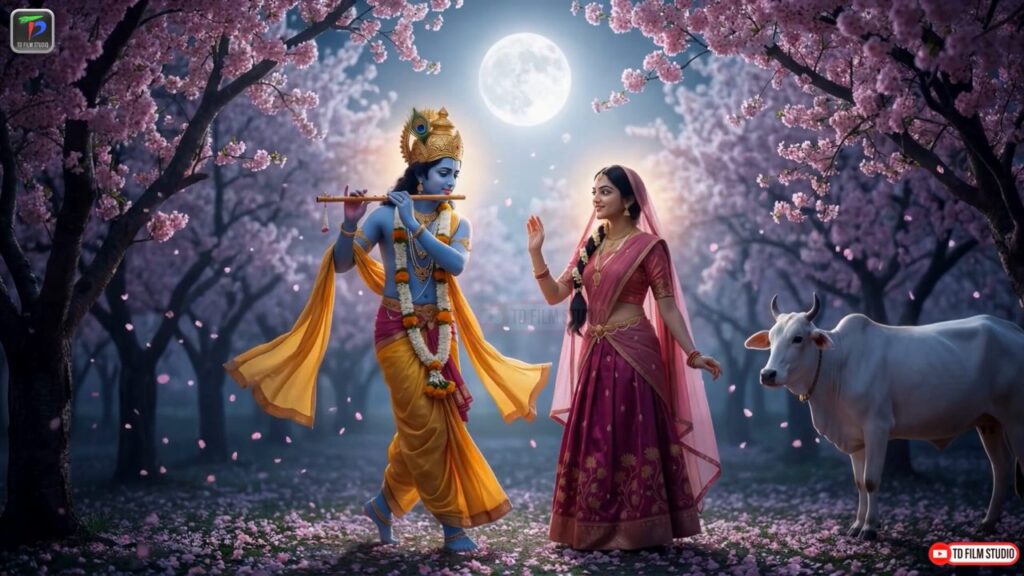
In the first two days I rejected the glossy calendar-painting look. I cast Radha’s face first: an ordinary young woman, no jewellery, no make-up. Divinity would come only from costume and light. I made 249 character images, locked both faces in three days, and then dressed the same face for every scene. For the farewell I chose black and gold, so her grief would read before a word was spoken.
Storyboard to animation
Krishna presses a red dot onto Radha’s turmeric palm and kisses it. I locked that close-up on my first board on 28 November and carried it unchanged to the final film. Other boards I redrew: on 23 December I recomposed the farewell so that Radha kneels with folded hands, not a lover begging but a devotee letting go. I drew 2,902 storyboard frames, and boarded the Maha Raas three times before it felt like a dance of the soul.
What does an animation director do with 848 clips?
Every approved still became the first frame of a moving shot: the river farewell, the tear, the Raas seen from the sky. I directed 848 animated clips, seventy-nine minutes in all, for a film of twenty-one. For every second you see, I made almost four, and kept only what held the story.
The blossom-orchard dance went through three passes. I rejected seven takes of it on a dark stage, moved it to an orchard under the full moon, and re-mastered it again six months after release. That is the work of an animation director on an AI-assisted film: not making shots, but choosing, rejecting and holding the line.
The edit, and my one regret
The film began as a music video of about eight and a half minutes and became a film of twenty-one. In the last four days I added the epilogue that answers why Krishna never returned. My one regret is the opening: my hook grew from one minute to nearly four, so Radha’s story begins at 4:04, and many viewers leave before she arrives. If you left early, start the film at 4:04.
Divine, and deeply human
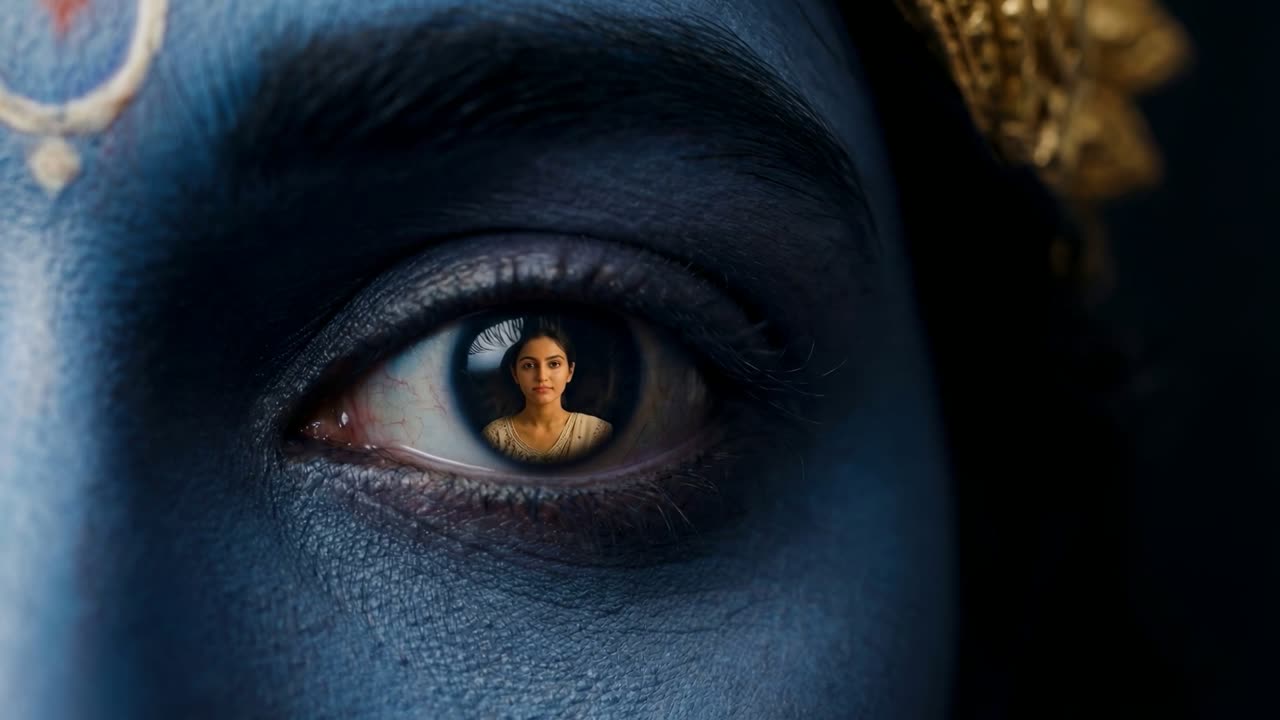
What I would not compromise on: Radha and Krishna as divine, and still deeply human. Tears with kajal in them. Each living in the other’s eye: look at 10:03, and in Krishna’s eye you see Radha; in hers, you see him. Separation shown not as abandonment, but as love’s deepest form. That single frame is the whole film.
More films, taken apart
Every film has its own page on our films page, and the devotional films are together under Hindu mythology animated films. The same method, on other stories:
- AI animation, behind the scenes: how we made Maa Kali vs Raktabeej
- Making of Amar Cotton College: old photographs to a music video
Commission a film from an animation studio in India
TD Film Studio is an animation studio in Guwahati, Assam. We make devotional, epic and story-driven animated films, music videos and commercials, AI-assisted, on a workflow built in-house over twenty years of filmmaking. Research, song, story, design, animation, edit and sound stay under one direction, so nothing is lost between departments. See our animated video production service, or tell us your story.
Frequently asked questions
Can AI make a movie?
It can make clips, not a film. A clip does not know what came before it or what must come after. Structure, continuity, performance and rhythm come from a director; Radha Krishna is AI-assisted animation, and every one of those decisions was made by hand.
What is the animation process for a film like this?
Research, the song, the story and screenplay, character design, the storyboard, animation, the edit and the sound, in that order. For Radha Krishna that meant 2,902 storyboard frames, 249 character images and 848 animated clips for a twenty-one-minute film.
What does an animation director do on an AI-assisted film?
Decides everything the tools cannot: what the story means, what each face and costume must say, which board becomes a shot, which of many takes holds the story, and where every cut falls. On this film I kept roughly one second of animation for every four I made.
How long did Radha Krishna take to make?
About six months, from the first song file in July 2025 to release in January 2026, with the main production in the last eight weeks.
Can TD Film Studio make a devotional animated film for us?
Yes. We make devotional, epic and story-driven animated films for temples, labels, festivals and organisations. Tell us your story on the start page.