

Rongali Bihu, also called Bohag Bihu, is the Assamese New Year and the biggest festival of Assam, celebrated in mid-April when the month of Bohag begins and spring arrives. “Rongali” means joy and colour: it is a week of Bihu dance and song, new clothes and gamosas, blessings from elders, and feasts of pitha and laru, beginning with Goru Bihu, the day of the cattle.
Assam has three Bihus, tied to the farming year. Rongali Bihu is the spring festival of sowing and new beginnings, and the one the whole state dances to.
Watch: Bihu Dance | Animated Tribute to Assamese Women, a TD Film Studio animated film from Guwahati.

Why Rongali Bihu is celebrated
Rongali Bihu marks the end of the old year and the start of the new one in the Assamese calendar, around 14–15 April. It arrives with the first rains of spring, when the fields are prepared for sowing and the trees bloom. It is a harvest-cycle festival at heart, a prayer for a good year ahead and a celebration of youth, love and the land. It is shared across communities in Assam, which is why it is often called the festival of the Assamese people as a whole.
The days of Rongali Bihu
Bihu is traditionally celebrated over seven days. The best known are:
- Goru Bihu (the cattle Bihu): on the last day of the old year, cattle are taken to the river or pond, bathed with a paste of black gram and turmeric, and gently struck with sprigs of makhiyati and dighloti leaves, with a rhyme wishing them health and strength. Their ropes are renewed. Cattle are honoured because the farming year depends on them.
- Manuh Bihu (the Bihu of people): New Year’s Day. People bathe, wear new clothes, seek the blessings of elders and offer them gamosas, the hand-woven white-and-red cloth that is a symbol of Assamese respect.
- Kutum Bihu: the day for visiting relatives and friends.
- Mela Bihu: the days of fairs and public Bihu celebrations.
- Chera Bihu: the closing day.
Many towns and villages now hold Bihu functions, the stage programmes of dance and song, through the whole month of Bohag.
Bihu dance and Bihu songs
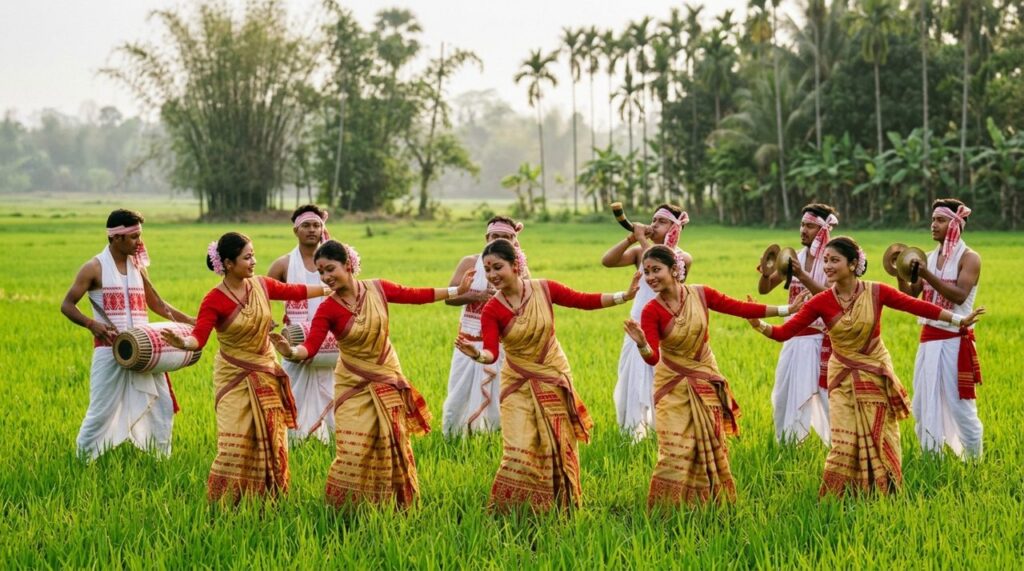
No festival in India is more closely tied to a dance. The Bihu dance is performed by young men and women in traditional dress: women in mekhela chador, often of golden muga silk, and men in dhoti and gamosa. It is fast and joyful, with swaying hips, flicking wrists and the steady beat of music.
The instruments are part of its identity:
- dhol, the drum that drives the dance;
- pepa, the buffalo-horn pipe whose cry opens it;
- gogona, the bamboo jaw harp played by women;
- taal cymbals and the bamboo clapper toka.
Bihu songs (Bihu naam) are songs of love, nature, youth and spring, often teasing and full of humour. Groups called husori go from house to house singing blessings for the new year and receive gifts in return. Modern Assamese music has carried Bihu songs to audiences across India, and the voice most associated with them for a generation was Zubeen Garg’s.
Food of Rongali Bihu
Bihu is a feast. Homes prepare pitha, rice cakes such as til pitha filled with sesame and jaggery, laru sweets of coconut and sesame, and jolpan, light meals of flattened, puffed or soft rice with curd and jaggery, served to guests throughout the week.
The three Bihus of Assam
| Bihu | When | Season | Mood |
|---|---|---|---|
| Rongali (Bohag) Bihu | Mid-April | Spring, sowing | Joy, dance, the new year |
| Kongali (Kati) Bihu | Mid-October | Crops growing, granaries empty | Quiet; lamps lit in the paddy fields |
| Bhogali (Magh) Bihu | Mid-January | Harvest | Feasting: Uruka night, the Meji bonfire |
“Rongali” means joy, “Kongali” means poor, because the granaries are empty in October, and “Bhogali” comes from bhog, enjoyment and feasting after the harvest.
Rongali Bihu wishes
The greeting is simple: “Happy Rongali Bihu”, with best wishes for the new year. Elders are greeted with respect and a gamosa; friends with song.
Bihu films from Guwahati
TD Film Studio is a film and animation studio in Guwahati. Our Bihu films include the animated Bihu Dance: Tribute to Assamese Women and the cinematic short Bohag Bihu: Rongali Bihu Husori and Bihu Dance.
- Watch our Assamese films and music
- Subscribe to TD Film Studio on YouTube
- Making a Bihu film, a music video or a festival campaign? Start a project
Watch: Bohag Bihu | Rongali Bihu Husori and Bihu Dance.

Frequently asked questions
When is Rongali Bihu celebrated?
In mid-April, at the start of the Assamese month of Bohag; New Year’s Day usually falls on 14 or 15 April.
Why is Rongali Bihu called Bohag Bihu?
Because it begins with the month of Bohag, the first month of the Assamese year. “Rongali” means joyful and colourful.
What is Goru Bihu?
The first day of Rongali Bihu, when cattle are bathed, honoured and given new ropes, wishing them health for the farming year.
What are the three Bihus of Assam?
Rongali (Bohag) Bihu in April, Kongali (Kati) Bihu in October and Bhogali (Magh) Bihu in January.
Sources: Bihu on Wikipedia; the studio’s own Bihu films and Assamese cultural tradition.