
Animation
Animated video production, from first idea to final master
Brand films, explainer videos, music videos and story films, written, designed, animated, scored and finished in one studio. The same studio made devotional films that passed 1.5 million views each.
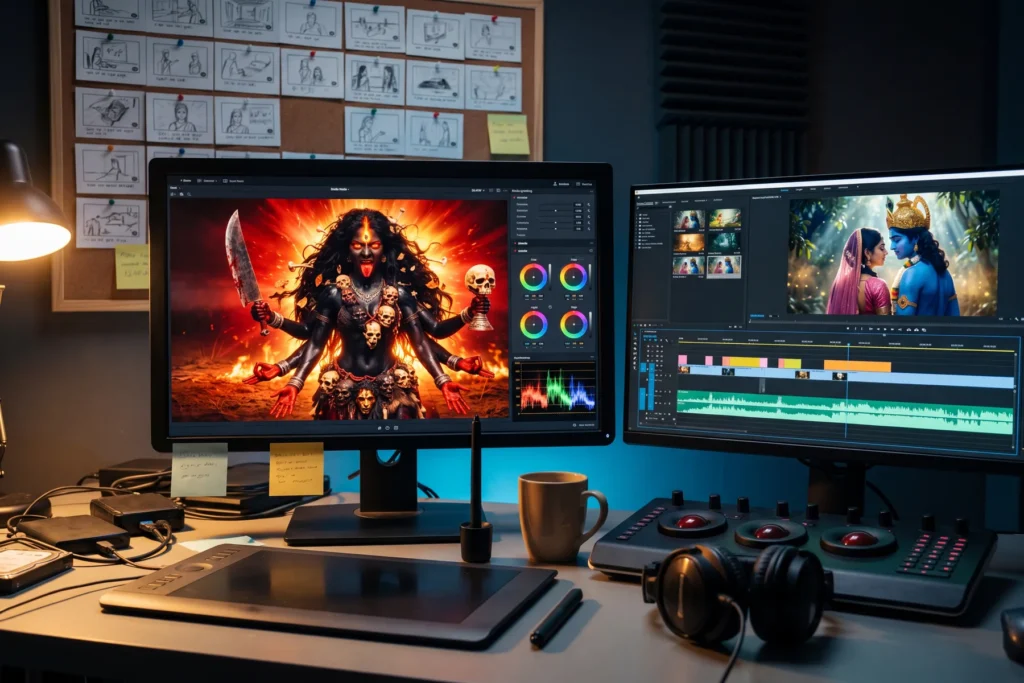
Services in this family: 2D animation · character animation · explainer videos · devotional and mythological films · children’s and family videos · animated music videos · See all 88 animated films on one page →
What we animate
Animated video production services
Animation lets a film go anywhere: into a product, a process, a myth or a memory. These are the animated films we make.
Brand and marketing films
Animated films that introduce a company, a product or a campaign, at cinematic quality. Explore brand and marketing films.
Explainer videos
For product, service and training films, see our animated explainer video production.
Animated music videos
Visual worlds for songs, from devotional music to independent artists. Explore animated music videos.
Story films and series
Short films, episodes and longer animated features, from screenplay to final mix. Explore story films and series.
Devotional and mythological films
India’s sacred stories, researched from scripture and designed with care. Explore devotional and mythological films.
Book trailers and children’s stories
Animated trailers and storybook films for authors and publishers. Explore book trailers and children’s stories.
On the record
Animated work on the record
- Shri Krishna’s Entire Life: over 1.5 million views
- Jai Maa Kali: over 1.5 million views
- Animated features My True Love (2021) and Sleeping Beauty (2024)
- Visual effects integrating animated elements with live actors for the feature Rador Pakhi (Morning Sunshine) (2024)
- Storyboards and character design concepts for Disney India’s Zokkomon
How we work
Craft first, tools second
The studio uses the newest production tools, including AI-assisted animation, and has done so since they became good enough to trust. They are the brush; the story, the design and the finish come from a director with twenty years of live-action cinema.
That combination lets a small studio deliver animated films at a scale and speed that once needed a large department. A director still checks every frame.
On the record
Animated films from the studio
Cinematic animated shorts made in the studio: science fiction, comedy, folklore horror, wildlife fantasy and films of Assamese culture, each written, designed, animated, edited and scored here.
 11:56Prehistoric Mistake
 2:15Futuristic Guwahati: 250 Years Later
 1:00Kaziranga: Riding the Giants of Assam
 0:59Meet Baak, the Shape-Shifting Demon of Assam
 1:10Bohag Bihu: Husori and Bihu Dance
 0:30Bihu Dance: A Tribute to Assamese Culture
 1:18Assamese Culture in Motion
 2:59A Virtual Escape
 1:28Soaring Wings of Wonder
 1:01The Scholar Rhino
 1:01Nightmare Chronicles: The Reign of Rat Terror
 4:33Bihu Dance: an animated tribute to Assamese women
 9:17The Legend of Baak
How it runs
How an animated film is made
- Brief: the audience, the message and where the film will live.
- Script and voice: written and approved first, because that is where change is cheapest.
- Design and storyboard: characters, worlds and every shot planned.
- Animation: shots built, reviewed at the animatic and first cut.
- Finish: music, sound design, subtitles and the final master.
Every stage has a named review gate. See the full process.
Questions
See a full animated feature: Sleeping Beauty, the studio’s realistic animated film of the classic fairy tale.
What to send us, and what you receive
A good animated film starts with a short, honest brief. You do not need a script or a storyboard to begin; you need to know who the film is for and what it must do. Send us:
- The one message. The single thing a viewer should remember, feel or do after watching.
- The audience. Who watches, in which language, and on which screen: a phone in a feed, a website, a television or a festival screen.
- Where the film will live. YouTube, your website, social media, broadcast, a presentation or an event, so the length and shape of every version are planned from the start.
- References you like. Films, illustrations or colours that feel right, and anything you know you do not want.
- Your materials. Brand guidelines, logos, product photos, an existing script or character, and any facts that must be checked.
- The date. When the film must be live, and whether a launch, a festival or an event fixes that date.
If your agency or in-house creative directors already have a concept, we work from their idea and plan it shot by shot. If you start with only a problem to solve, the studio writes the idea with you. Either way, you receive a written plan before anything is animated.
At the end you receive a finished master and every version agreed at the start: lengths, aspect ratios, language versions and subtitle files. Formats include H.264 for the web and ProRes for broadcast or further editing. Usage rights are written into the agreement before work begins. For other languages, see subtitling, translation and dubbing.
Inside the studio: the tools, and who directs them
People often ask how a small studio can produce video of this standard at this scale. The answer is a pipeline in which new tools, including AI, do the heavy lifting while a director makes every decision. This is how creating animations works here, stage by stage:
- Script and storyboard. Written and planned first, because no tool can decide what a film should say. See scripts and storyboards.
- Characters and worlds. Each character and location is designed and locked on a reference sheet, with images developed in Nano Banana and corrected until they match the approved design.
- Motion. Shots are animated from those locked references in Kling and Seedance, then reviewed one by one. A shot that drifts from the design is redone, not excused.
- Visual effects and compositing. Fire, water, light, weather and other special effects are layered and cleaned in After Effects, the same visual-effects craft behind more than 1,500 shots on the feature Avataran. See visual effects.
- Voice, music and sound. Voices are cast and directed; songs and scores are written and produced in the studio, with Suno among the tools used under direction. See music and sound.
- Edit, colour and finish. Cut, graded and mixed into a high quality master. See post-production.
The tools change every few months; the method does not. A story is written, a look is designed and approved, and every frame is checked against that approval before it leaves the studio.
Choosing a look: 2D, 3D animation or realistic cinematic
The look of an animated film should follow its purpose. Three broad choices cover most projects, and they can be combined:
- 2D and motion graphics. Illustrated characters, animated type and icons. Clear, flexible and easy to update, this look suits explainers, children’s stories and series for social media. See 2D animation services.
- 3D animation and the three-dimensional look. Depth, camera movement and light that behave like a real space. It suits products, places and worlds that need to feel solid, and it can sit alongside 2D elements.
- Realistic cinematic animation. The look of the studio’s devotional films and its realistic Sleeping Beauty: characters and worlds that feel filmed rather than drawn. It suits myth, fairy tales, drama and brand films that need emotional weight. See devotional and mythological films.
If you are unsure, send the brief with two or three references. You will receive a recommendation with the reasons for it, and a style frame to approve before animation starts.
Formats for every screen
Decide where the film will be watched before it is designed, because the frame shapes the composition. A film framed only for a wide screen loses heads and titles when it is cropped for a phone.
- 16:9 horizontal for YouTube, websites, television and presentations.
- 9:16 vertical for Reels, Shorts and stories on social media, composed for the phone from the start rather than cropped later.
- 1:1 or 4:5 for feeds, where a square or near-square frame fills more of the screen.
- Cut-downs of fifteen, thirty or sixty seconds from a longer film, with burned-in subtitles for viewers who watch without sound.
Planning these versions together keeps every one of them consistent, and takes far less work than rebuilding a film after it is finished. Language versions are covered on subtitling, translation and dubbing.
Mistakes that slow an animated film down
- Changing the script after animation starts. Words are quick to change on paper and slow to change on screen. Approve the script and the voice before design begins.
- Too many messages. A one-minute film carries one idea well; three ideas fight each other.
- Approving by committee at the end. Bring every decision-maker to the script and style-frame reviews, not only to the final cut.
- Forgetting languages and versions. Tell us early if the film needs Hindi, Assamese, Bengali or other versions, so on-screen text and timing allow for them.
- No plan for where it will run. A film made for a website and later pushed to social media without a vertical version rarely reaches the audience it could.
See how each review gate works on the process page, browse finished work on films, or start your animated film.
Reviews, approvals and changes
Every animated film here passes the same review gates, and each gate asks you to approve one specific thing. Knowing what each gate is for makes notes faster and changes cheaper.
- Script and voice. You approve the words and the recorded voice.
- Style frame and character sheets. You approve the look: colours, characters and the world. These become the reference every shot is checked against.
- Animatic or first cut. You approve the order, timing and length of the shots before the final animation and effects are layered on.
- Final master. You check spelling, logos, facts and the mix, then sign off for delivery.
The studio now animates directly from approved character and location references into motion. That gives better movement, but it means a change to an approved shot is a remake of that shot, not a quick fix. So notes are gathered from every decision-maker at each gate, in one list, and the agreement sets out how changes after approval are handled.
Captions, accessibility and life after delivery
On request, each master comes with a subtitle file. Platforms can then show closed captions for viewers who are deaf or hard of hearing, or who watch with the sound off. On-screen text is large enough to read on a phone and stays long enough to read twice. Its colours stand out clearly against the picture.
A good animated film also keeps working after launch. Because characters and worlds are locked on reference sheets, the same designs can later carry:
- an updated figure, date or product shot, without remaking the whole film;
- a new language version, or a new length for another platform;
- a sequel, a festival greeting or a series episode with the same characters;
- stills and key art for posters, thumbnails and print, through design for films and brands.
Whether the project files are handed over, and how long they are kept, is agreed in writing at the start. To plan a film with all of this in mind, start your project.
Questions about animated video production
How much does an animated video cost?
Cost follows length, style, the number of characters and the amount of change after approval. Explainers cost less per minute than character-driven story films. You receive clear options with a written quote, rather than a price list.
Why does animation cost money?
Every frame is designed and made rather than filmed: script, design, storyboard, animation, voice, music and sound are all separate crafts. Keeping them in one studio, with one team, is how we keep that cost honest.
How long does an animated video take?
A short explainer can be delivered in a few weeks from an approved script; longer story films take longer. The delivery date is agreed in writing at the start.
Do you use AI in your animation?
Yes, as one tool among many, and always directed. Every frame is chosen, corrected and finished by the director, and usage rights are set out in writing.
Can you animate in other languages?
Yes. We deliver subtitled and dubbed versions, so one film can serve several markets.
Is TD Film Studio an animation studio in Guwahati?
Yes. TD Film Studio is an animation studio in Six Mile, Guwahati, founded in 2011. Its animated films have been watched more than 7 million times, and it makes animated videos for clients in Guwahati, across India and worldwide.
Related services
- Character animation services: characters designed and performed
- 2D animation services: illustrated and motion-graphic animation
- Commercials and corporate films: TV commercials, digital ads, and brand, training, event and institutional films
- The studio on YouTube: films, song-films and devotional cinema
Start your animated film
Tell us what you want to make. You will hear back within one working day.