There is a chapter in the Bhagavata Purana where nothing happens.
No demon is killed. No mountain is lifted on a fingertip. A young cowherd walks into the forest at the end of the day, lifts a length of bamboo to his lips, and plays. That is the entire event. And the text then spends a whole chapter describing what listening does to the world.
It is called the Venu Gita — the Song of the Flute. It is one of the most quietly radical passages in Indian scripture, and it is the source our new film is built on.
What is the Venu Gita?
The Venu Gita is Book X, Chapter 21 of the Bhagavata Purana. It is short, and it is positioned with great deliberation: it comes before the Rasa Lila, the great circle dance that unfolds across chapters 29 to 33.
That order matters more than it appears. The tradition does not begin its supreme love story with a meeting. It begins with a sound. The flute calls first, and everything that follows — the gathering, the dance, the longing, the union — is a response to a call that went out before anyone had seen who was making it.
The Bhagavata’s whole argument about God is compressed into that sequence. This is a tradition which holds that the divine is approached most truly through sweetness rather than through awe. Not a ruler who summons. A boy in a forest, playing.

What happens when Krishna plays the flute?
The chapter is a catalogue of interruptions. Every living thing in Vrindavan is caught mid-action, and the text is unusually specific about it.
The river stops moving
The Yamuna’s current slackens and its surface settles into glass. Lotuses lift. The wind drops. The forest, the text says, breaks into fragrance — as though scent itself were a form of attention.
The animals forget to chew
This is the detail that stays with you. The deer at the water’s edge do not run and do not approach. They simply stop, with mouthfuls of grass still held between their teeth, ears erect, unable to swallow — standing so completely still that the scripture compares them to figures in a painting.
Not tamed. Not charmed. Suspended. Something arrived that the ordinary business of being alive could not continue through.
The village puts down its work
Then the sound reaches human hands, and the Venu Gita becomes a record of abandoned tasks. A gopi’s fingers open and the churning-stick swings free. A water-pot tips from a hip and is not caught. A lamp is left half-lit in a doorway. One of them, the text says, forgets her own name.
Nobody is persuaded. Nobody decides. They hear, and the thing they were doing simply stops mattering. If you have ever wondered what the tradition means by bhakti, it is not the ecstasy at the end of that road. It is this moment — the instant the churning-stick is let go.
Why the gopis were jealous of a piece of bamboo
Here the chapter takes its strangest and most beautiful turn, and it is the reason the Venu Gita is loved by people who know it well.
The gopis watch Krishna raise the flute to his mouth, and what rises in them is not devotion. It is envy. Of the bamboo. Because that bamboo is drinking from his lips, and they are not.
And they interrogate it. What did you do to deserve this? What austerity did you perform, what vow did you keep, that you should be held there while we stand at a distance? The text pushes the point further still: even Sri — the goddess of fortune, who by definition lacks nothing — is said to long for that place.
The flute never answers. It does not have to. The answer is its own construction.
Why is Krishna’s flute hollow?
A bansuri is a length of ordinary bamboo with the pith burned out of it.
Nothing was added to make it sing. Something was removed. The holes are not damage; the holes are the instrument. It performed no austerity and kept no vow. It was cut down, hollowed, and pierced — and everything that had been its own was taken out of it. That emptiness is its entire qualification.
Which is why the flute is bamboo and not gold. Gold is solid, and a solid thing cannot sing. The twentieth-century mystic Osho read the flute exactly this way — as the image of the perfected devotee, empty enough for the breath of God to pass through and become music. It is an interpretation rather than scripture, but it is a true reading of what the object is.
The teaching is uncomfortable in the way that real teachings are. The tradition is not asking you to acquire devotion. It is asking what you would have to put down.
खाली जो बाँस · उसी में श्वास · बाजे कान्हा की धुन
The bamboo that is empty — in that very emptiness, the breath sounds Kanha’s tune.
What most retellings get wrong about Radha
Open the Bhagavata Purana at the Rasa Lila — the most famous love story in the tradition — and look for Radha’s name.
It is not there.
The supreme beloved is present on every page. She is simply never named. In the Bhagavata she is the unnamed gopi, the one whose love is greatest, and the text leaves her anonymous. The name Radha arrives centuries later, principally through Jayadeva’s twelfth-century Gita Govinda and then the Chaitanya tradition that followed.
This is sometimes reported as though it were a demotion. It is the opposite. What the later tradition brings is not merely a name but a definition: Radha is Krishna’s hladini shakti — his own capacity for bliss, turned back toward him and given a face. She is not a woman who loves God from outside. She is the joy of God, looking at God.
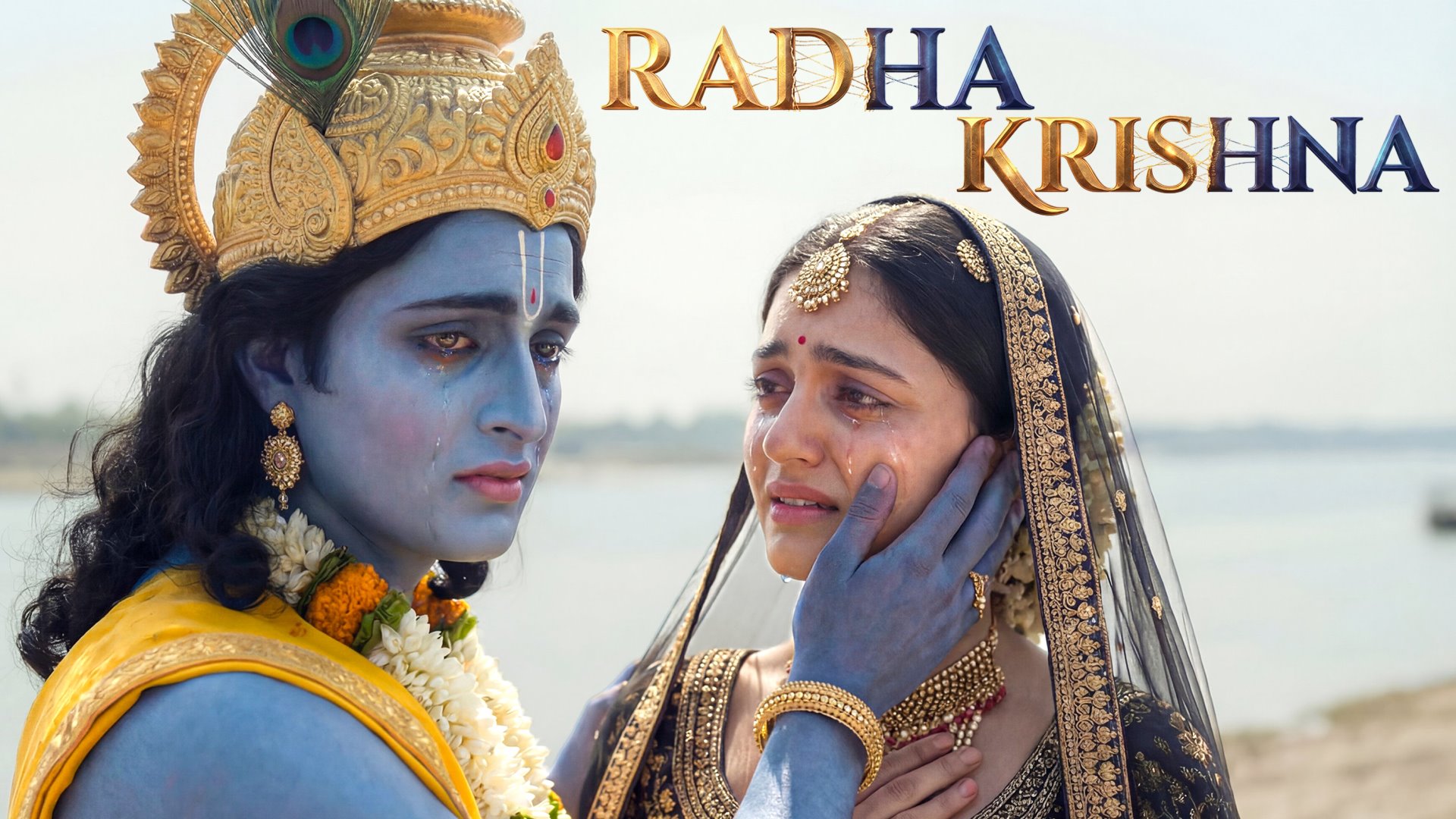
Understand that and the emotional logic of the whole cycle changes. The peak of the Venu Gita is not a meeting. It is a woman standing perfectly still while everyone else moves — because for her the flute is not a sound but a name being called, and it is hers. In this tradition, longing is not the distance from love. Longing is love, at its highest pitch. The word for it is viraha, and the Bhagavata treats it as a summit rather than a wound.
Making Shri Krishna: The Eternal Flute
We spent a long time on the Venu Gita before writing a line, and the research changed the film.
The first thing it settled was the order. Our film opens the way the chapter opens — in near-darkness, on lips and bamboo, with a single breathy note before there is anything to look at. Sound arrives before sight, because that is the argument the source is making.
The second was the ending. Every instinct in filmmaking says to swell at the close. We did the opposite: the score strips back to one sustained tone, Krishna lowers the flute, his eyes meet the lens, and the last light of the film passes straight through the empty bore of the bamboo and out the other side. Nothing is narrated over it. A film whose whole argument is that emptiness makes music possible cannot fill up in its final thirty seconds.
The song came first — all of it, written, composed and sung before a single frame existed, because the audience for a devotional film is carried by sound, not picture. The lyrics are original Hindi and the composition is registered with the Screenwriters Association. Every one of the fifty shots was then cut to that finished track.
The gopis are not a crowd. Seven of them are cast individually as sakhis from the Ashta-Sakhi tradition — Lalita, Vishakha, Indulekha, Champakalata, Tungavidya, Rangadevi and Chitra — each with a fixed costume colour, a fixed nose ornament and a fixed hairstyle held across the entire film, so that seven distinct people answer the same call in seven distinct ways. Which is, in the end, the Venu Gita’s actual subject.
The animation is AI-assisted and disclosed as such. The screenplay, the song, the lyrics, the vocal performances, the edit and every directorial decision are human work, and the film was built on a locked reference library of characters and eighteen Vrindavan locations drawn before any shot was generated.
Watch the film
Shri Krishna: The Eternal Flute runs five minutes and thirty-four seconds, in Hindi with English subtitles. It is free to watch.
If it reaches you, the most useful thing you can do is send it to one person who needs to hear a flute today. Films like this do not travel by algorithm. They travel by hand.
Frequently asked questions
What is the Venu Gita?
The Venu Gita, or Song of the Flute, is Book X, Chapter 21 of the Bhagavata Purana. It describes the effect of Krishna’s flute on the natural world and the people of Vrindavan, and it precedes the Rasa Lila in chapters 29 to 33.
Why is Krishna’s flute made of bamboo and not gold?
Because a bansuri is made by removal rather than addition — the pith is burned out so that breath can pass through. The hollowness is the instrument’s whole capability, and the tradition reads it as an image of the surrendered devotee: empty enough for the divine to sound through.
What is Krishna’s flute called?
Several names are used, and they are not quite interchangeable. Venu and vamshi are the Sanskrit terms for the bamboo flute; murali is the common devotional name; bansuri is the Hindi word for the side-blown Indian flute played today.
Is Radha in the Venu Gita?
Not by name. The Bhagavata Purana never names Radha, in the Venu Gita or in the Rasa Lila — she appears as the unnamed supreme beloved. The name enters the tradition later, chiefly through Jayadeva’s Gita Govinda in the twelfth century and the Chaitanya tradition afterwards.
What does the flute symbolise in Hinduism?
It is most often read as the call of the divine to the individual soul, and as an image of surrender. Sound reaches the listener before form does, which is why the flute is understood as the first way God becomes perceptible — and the emptiness of the bamboo stands for the ego that had to be given up.
Did Shiva really take the form of a gopi to hear the flute?
That story belongs to Vrindavan’s own tradition rather than to the Bhagavata Purana. It holds that Shiva, hearing the flute from Kailash, came to join the Rasa and was refused entry because no man may enter it but Krishna; he bathed in the Yamuna, rose in the form of a gopi, and was admitted, whereupon Krishna named him Gopeshwar — Lord of the Gopis. The Gopeshwar Mahadev temple in Vrindavan is where this is remembered, and Shiva is dressed there as a gopi to this day.