
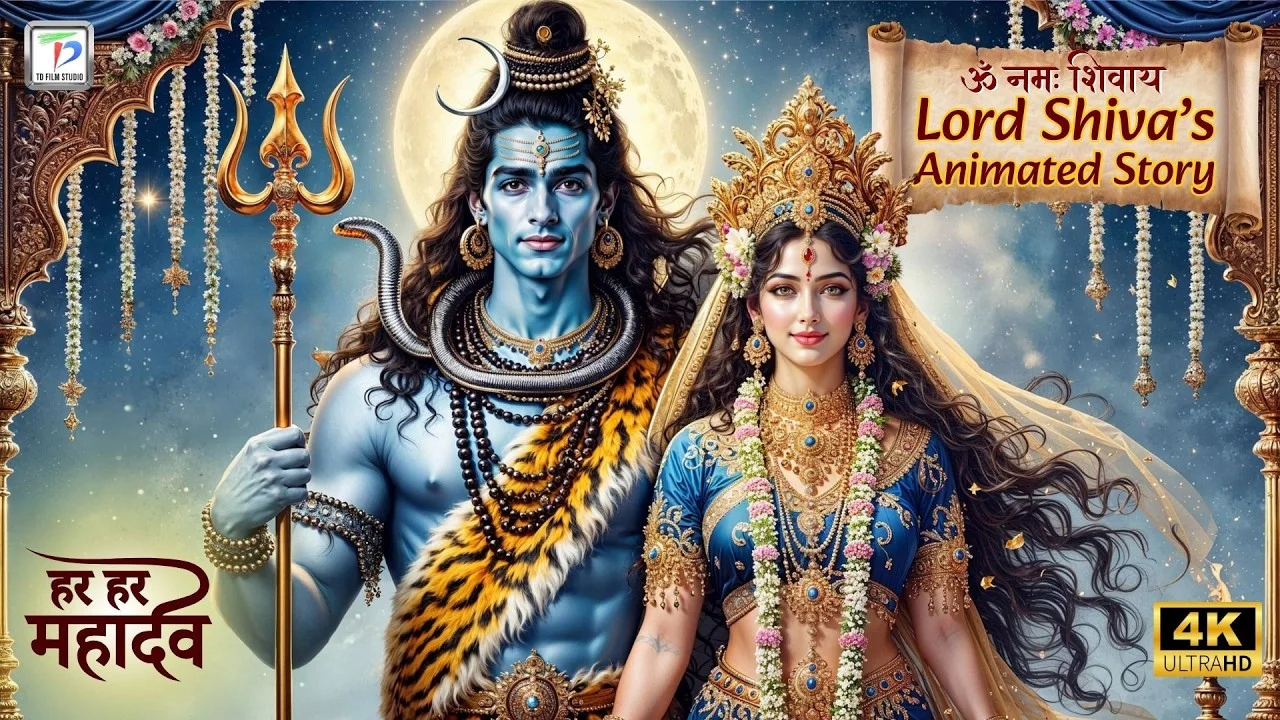
Lord Shiva is one of the principal gods of Hinduism: the destroyer and transformer in the Trimurti with Brahma the creator and Vishnu the preserver, and, for the Shaiva tradition, the Supreme Being himself. He is Mahadeva, “the great god”: the ascetic yogi of Mount Kailash, the cosmic dancer Nataraja, the husband of Parvati and the father of Ganesha and Kartikeya.
Shiva destroys so that the universe can be renewed. He is fierce and gentle at once: the god who drinks poison to save the world and the god pleased by a single leaf offered with love. Here is who he is, what his symbols mean, and the stories that made him.
Watch: Lord Shiva Story in Animation | Om Namah Shivaya Song, by TD Film Studio. Watched more than 550,000 times.


Shiva in the Trimurti
Hindu tradition describes three great functions of the divine: creation, preservation and dissolution. Brahma creates, Vishnu preserves and Shiva dissolves. Dissolution is not an ending but a clearing: when an age has run its course, Shiva’s dance, the Tandava, brings it to a close so that a new one can begin.
For millions of Shaivas, however, Shiva is not one god among three. He is the Supreme Reality, the source of creation, preservation and dissolution alike, worshipped above all in the form of the lingam, the formless pillar of light.
The symbols of Lord Shiva and their meaning
- The third eye: the eye of higher wisdom. When it opens, it burns away ignorance and desire; it reduced Kamadeva, the god of love, to ash.
- The crescent moon: worn in his hair, the moon marks time and its cycles, which Shiva rules.
- The Ganga in his hair: when the river descended from heaven, Shiva caught her in his matted locks so her force would not shatter the earth.
- The serpent around his neck: Vasuki the serpent king, a sign of mastery over fear and death.
- The blue throat (Neelkanth): at the churning of the ocean, a deadly poison, halahala, rose and threatened all life. Shiva drank it, and Parvati held it in his throat, which turned blue.
- The trident (trishul): its three points are read as creation, preservation and dissolution, or as the three qualities of nature.
- The damaru: the small drum whose rhythm, it is said, gave rise to sound and language.
- Ash on his body: a reminder that every form returns to dust, and only the spirit endures.
- Nandi the bull: his mount and devoted gatekeeper, who sits facing the shrine in every Shiva temple.
The great forms of Shiva
- Nataraja, the lord of dance, whose cosmic dance moves the universe through creation and dissolution.
- Ardhanarishvara, half Shiva and half Parvati: the divine as both masculine and feminine, inseparable.
- Rudra, the fierce storm god of the Vedas, from whom Shiva’s worship grows.
- Bhairava, the terrifying protector.
- Dakshinamurti, the silent teacher who instructs through stillness.
- Mahayogi, the great ascetic in meditation on Mount Kailash.
Shiva’s family
Shiva’s first wife was Sati, the daughter of King Daksha. When Daksha insulted Shiva at his sacrifice, Sati gave up her body in her own yogic fire. Grief-stricken, Shiva withdrew into deep meditation, until Sati was reborn as Parvati, the daughter of the mountain king Himavan. Through years of austerity she won him again.
Their sons are Ganesha, the remover of obstacles, and Kartikeya (also called Skanda or Murugan), commander of the gods’ army.
Why Shiva is worshipped
Devotees turn to Shiva as the god who destroys what binds us: ego, fear, ignorance and attachment. He is easy to please (Bholenath, “the innocent lord”) and asks only for sincerity. His great festival is Maha Shivratri, the night when devotees fast, keep vigil and offer water, milk and bel leaves to the lingam, chanting the five-syllable mantra “Om Namah Shivaya.”
His sacred sites span the subcontinent, from the twelve Jyotirlingas, including Kashi Vishwanath in Varanasi and Somnath in Gujarat, to Mount Kailash in Tibet, his traditional home.
Watch Shiva’s story
TD Film Studio tells India’s sacred stories as animated cinema. Our Lord Shiva Story in Animation sets his story to Om Namah Shivaya. Our devotional films also include Maa Kali vs Raktabeej and Shri Krishna’s Entire Life.
Frequently asked questions
Who is Lord Shiva in Hinduism?
Shiva is one of the principal Hindu gods: the destroyer and transformer in the Trimurti, and for Shaivas the Supreme Being. He is worshipped as Mahadeva, the great god.
Why is Lord Shiva’s throat blue?
At the churning of the ocean he drank the deadly poison halahala to save the world. Parvati stopped it in his throat, which turned blue, giving him the name Neelkanth.
Who are Shiva’s wife and children?
His wife is Parvati, the rebirth of Sati. Their sons are Ganesha and Kartikeya.
What is Shiva’s mantra?
The five-syllable mantra “Om Namah Shivaya” is the most widely chanted prayer to Shiva.
Sources: the Shiva Purana and the Linga Purana; Shiva on Wikipedia; Encyclopaedia Britannica, “Shiva”.