
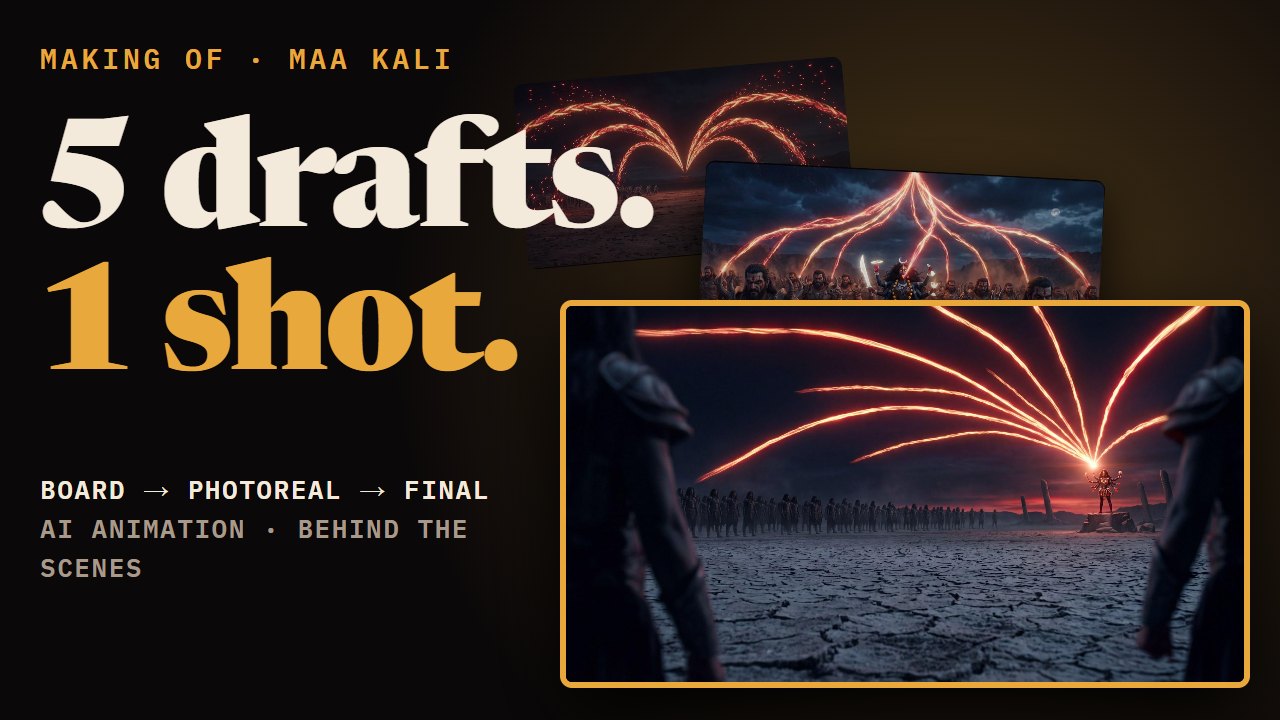
Making a 15-minute AI animated film took eight stages: scripture, song, story, design, storyboard, animation, edit and sound. It also took a lot of rejected work: 632 storyboard frames, 189 animated clips, and a first cut in which only 16% of the shots survived as planned. Here is how Maa Kali vs Raktabeej was made, with the real numbers and the lessons you can use.
The making-of film, told by its director. The finished 15-minute film is here: Maa Kali vs Raktabeej on YouTube.
1. It started with a song, not a script
The film’s spine is an original song. The Director’s core lyrics came first, and before a single word was set, the song’s shape was designed like a screenplay: ten sections, each with its own feeling, a key lift on “Chamunda!”, a beat drop for the first drink, double time for the dance, and eight seconds of total silence before Shiva.
Then the generated track came back at 5:39 instead of 7:00, and it never fell silent. The same day (7 July 2026), the storyboard was rebuilt to the real song.
Tip: plan from the audio you have, not the audio you intended.
2. The story grew to fit the film
A 30,000-word source story became a 7-minute plan, a 5:39 song, a 14:17 first cut and finally a 14:55 film in eleven segments, from the fall of heaven to a child at dawn. The mantra was matched to the moment: the chorus names Chamunda, so it plays where Kali earns that name.
3. Build every character before a single shot

Each lead character was built as a chain: an approved face first, then the body, a head turnaround, an expression sheet and a body turnaround, all made from that face. The result was a visual bible of about a hundred identity images at 4K: characters, locations and props, on a neutral grey backdrop.
Designs changed on the way. Ambika grew from two arms to eight; Nishumbha went from a stone giant to a helmeted war prince; a horned Raktabeej was tried and rejected.
Tip: the approved plate is the character. Attach it and stop describing. Around 17,000 words of costume description were removed from the shot prompts, because extra words compete with the picture, and win wrongly.
4. Storyboard every shot twice

79 shots × 4 beats × 2 variations = 632 storyboard frames, painted first and then made photoreal. One shot, Rivers Into Her, went through a four-beat grid, a painted board, a first photo pass, a photoreal frame and a final frame before it was animated.
The hardest lesson came here. A costume rule said “never skulls”, and skulls appeared in about half of Kali’s frames. 162 of 632 frames failed full-size checks (47% in the worst segment), and 160 were made again.
Tip: a noun in a negative is still a noun. Describe only what is there, the way a costume maker would. And check every frame at full size: half the defects in the worst segment were invisible on the contact sheet.
5. From image to animation
This is the image to animation step. Each approved still became the start frame of a 15-second animated shot, and inside each shot the cuts were written out in advance: longer opening shots, quicker strikes, one held landing. The production made 189 animated clips (almost 40 minutes of 4K), and 159 of them are in the final edit.
Tip: never cut evenly. Acceleration is what makes a sequence feel alive.
6. Let the edit win
When the first cut was compared shot by shot with the storyboard, only 16.3% of its 465 shots had been used as planned. 38.5% were invented in the edit, including a whole two-minute prologue in the heavens that never existed on the storyboard. The naming of Chamunda became a wordless six-shot consecration; Raktabeej’s drops became glowing seeds; Kali stopped catching drops one by one and drinks every clone at once.
Tip: a storyboard is a scaffold, not a contract.
7. Sound: narration only in the gaps
Twelve short narration cues (383 Hindi words, about three minutes) sit only where the song breathes, never over sung words, and the climax is left to music and silence. Seven picture edits, five sound sessions and 127 English subtitle cues later, the film premiered on 9 October 2026.
Why AI tools alone cannot make a film
AI animation tools are not built for storytelling. They make shots; they do not make films. Structure, continuity, performance, coverage and rhythm come only from the filmmaker, and clips stitched together are not a film. Every decision above, from the song’s silences to the shots invented in the edit, was a human one.
What this means if you want a film made
TD Film Studio makes devotional and epic animated films from the first lyric to the final mix: scripture-true stories, an original song as the spine, characters locked shot to shot, and every frame checked at full size before it moves. Every film is human-directed. AI animation is our tool; the direction, the story and the craft are ours.
▶ Watch the finished film · Read the story of Raktabeej and Kali · Animated film production · Script and storyboard services · Commission your film
Ready to start? Tell us about your film on the project page. To see the finished films first, browse our devotional films or every film from the studio.
Frequently asked questions
How long did the film take to make?
The core production ran about five weeks, from the song session in early July to the final export on 11 August 2026; the film premiered on 9 October 2026.
How many images and clips were made?
More than 1,500 generated images across design and storyboard, 632 storyboard frames, and 189 animated clips, of which 159 are in the final film.
Can AI animation keep a character consistent?
Yes, if the character is locked first. Every shot in this film inherits from an approved identity plate, and frames that drifted were blocked and remade.
Is the film AI-generated?
The images and motion were made with AI animation tools under human direction. The story, the song’s lyrics and music, the storyboard, the edit and the sound were directed by Tarunabh Dutta, and the film carries YouTube’s altered-content label.
Can I commission a film like this?
Yes. Tell us your story, your song or your scripture, and we will shape it into a film: contact TD Film Studio.