
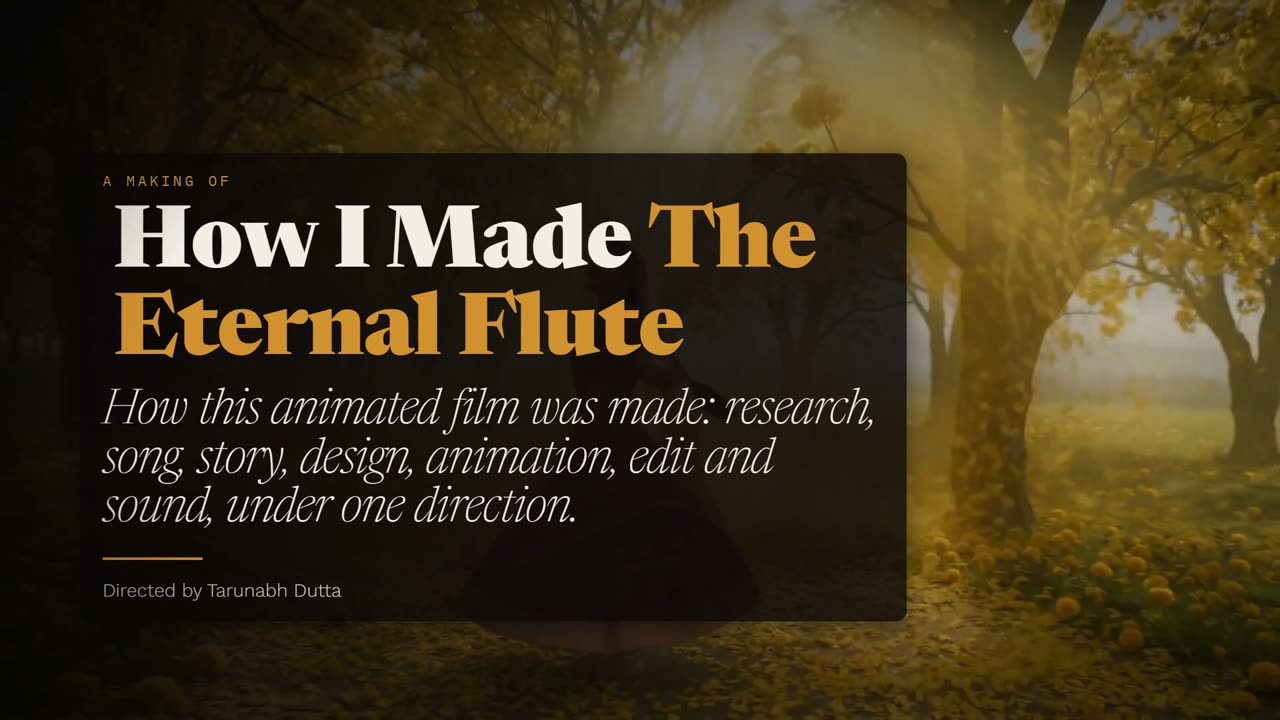
This is how I made The Eternal Flute, a five-minute animated Krishna film, from the first page of research to release. If you have ever wondered how to make an animated film, or what an animation studio actually does with nine months, this is the honest answer, with every number taken from my own production records. You can watch the finished film here, and read the story and the song on the film page.
I am Tarunabh Dutta, and I direct films at TD Film Studio in Guwahati, Assam. The film I am going to take apart runs five minutes and thirty-five seconds. The making-of above runs eight and a half. Everything in between is decisions.
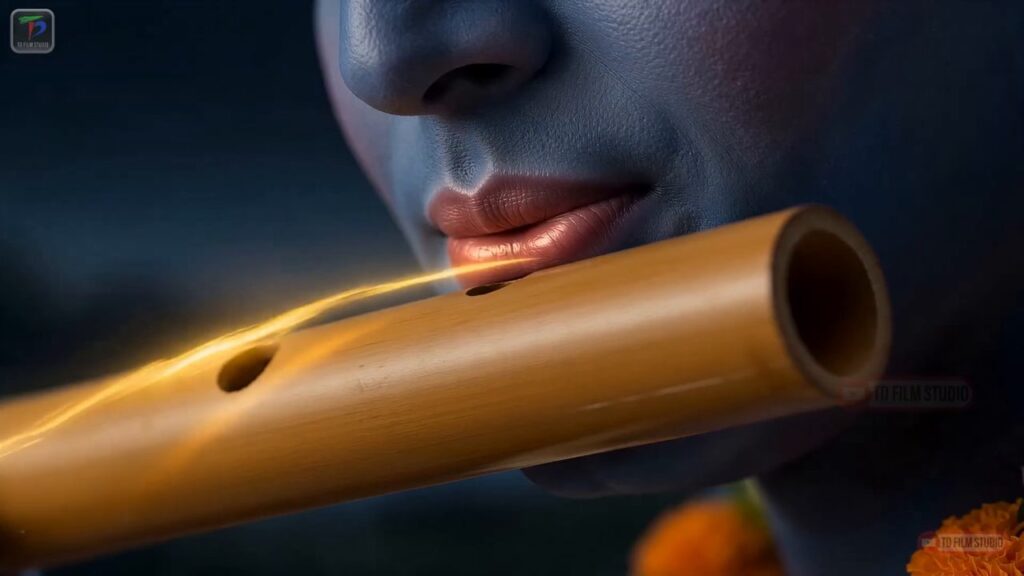
Can a tool make a film for you?
No, and I say that after using the tools every day for nine months. A tool gives you a clip. It does not give you a film. A clip is a few seconds of something that looks right. A film is a chain of decisions in which each shot earns the next one: structure, continuity, performance, coverage and rhythm. None of that lives in any tool.
If you put generated clips side by side, you get something that plays, and viewers leave it in twenty seconds, because nothing in it is going anywhere. That gap between clips and a film is the whole job of a director. It is also exactly what you are paying a studio for.
Where does the story come from?
The Eternal Flute is built on the Venu Gita, the Song of the Flute, in the tenth book of the Bhagavata Purana. When Krishna plays, the river stops. The deer forget to chew. The women of Vrindavan set down whatever they are holding and walk towards a sound they cannot name. I read it as a story about attention, not desire, and I wrote about the scripture itself in why Krishna’s flute is hollow.
Before a single frame existed, I wrote seventy-five music prompts, nine drafts of the script and eighteen lines of lyric. The teaching the whole film turns on was already on page one of the earliest file: a bamboo makes music because it is empty.
How to make an animated film: the ten stages
I made this film in ten stages, and I did not let one stage start until the one before it held:
- Research: the scripture first, then the commentaries, then the images people already carry in their heads.
- Song: written, recorded and cut before the story was fixed.
- Story: the structure, built to the song.
- Design: every face, costume and place locked before anything moved.
- Storyboard: every shot boarded three times.
- The stop: a full review of my own finished plan, before animation.
- Animation: each approved frame turned into a moving shot.
- Edit: the shots cut to the song, and then against it where the story needed it.
- Sound: the mix, the stems and the subtitles.
- Release: the film, its page, and its campaign.
The song came before the words
I wrote and cut the song overnight: sixteen takes in three and a half hours. The next morning I threw away two of my own documents, because they had been built on a song that no longer existed. Twenty-one takes in, the song had lost two and a half minutes and found its shape. For a day and a half the empty-bamboo idea had been a picture and a thesis. After that night, it was in the song.
Why the structure moved four times
The structure began as six movements and fifty-one shots. Then it became eighteen. Then fifty-eight. It settled into ten chapters and one arc: the flute calls, the world stops, and a teaching lands at the end. People ask why the film is so simple. It is simple because that is the point. The gopis are not drawn to spectacle. They are drawn to a sound. Everything that did not belong, I took out.
How do you keep a character the same in every shot?
One face had to survive every shot, so I locked it before anything moved: a reference, a costume master, turnarounds, expressions and a locked plate that every later image was generated against. Fifty-five designs were set aside before one was kept, and every one of them is still on my drive.
One of them was wrong in a way that taught me something. I put a crown on Krishna, and it made him a king. In this story he is a cowherd. So the crown came off, and the peacock feather went back into his hair. That is a research decision, not a visual one, and no tool would have made it.
Why every shot was boarded three times
Every shot went through three boards: a four-panel grid to choose from, the panel I chose cut out, and then a full-frame re-render at four times the pixels. Six minutes and fifteen seconds passed between the grid and the final frame. That is what a decision costs when you already know what you want.
I had also written a painterly visual style into four separate documents. Eighteen hours later I killed it, and there is not one file of it left. Being wrong on paper is cheap. Being wrong in a finished render is not.
The night I threw my own plan away
At half past one in the morning I wrote down what was wrong with my own finished plan. Forty-five seconds of beautiful, empty nature. The god himself withheld from the viewer for two minutes and twenty seconds. And I had already made a hundred and thirty-eight images for eight of those shots.
I struck twenty-two shots that night, and thirty-five minutes later I started again. In the finished film Krishna arrives at three seconds instead of two minutes twenty, an empty avenue became an avenue with Radha running through it, and the film does not say its own name until four minutes twenty.
From storyboard to animation
A closed bud in the board; in the shot, it opens. That pair is the whole method: what the board decides, the shot delivers. I animated sixty-seven shots in twenty-nine hours and forty-six minutes of generation, and I kept one frame for every one and three quarters I made. Fifty-eight shots reached the final film: some exactly as planned, some re-shot, and some invented at the desk during the edit.
The edit, the sound and the release
The film runs eighty-one seconds longer than its own song. All of that time is the teaching, the title and the credits, time the music was never written for. The finish is seventeen stems, four subtitle files and three edits before the one that went out. I released the film before the festival, and then released it again into the festival with a second wave built from scratch.
What did the film turn out to be about?
A bamboo makes music because it is empty. It has nothing of its own; everything that comes out of it is breath. When I cut a third of the film away, that idea survived, not because I protected it, but because I shortened it. The last thing I animated, the sixty-seventh shot, was a flute lying in an open hand with nobody playing it. The instrument is hollow. The breath is yours.
More films, taken apart
Every film we make has its own page on our films page, and the devotional ones are gathered under Hindu mythology animated films. These making-of films show the same method on very different stories:
- Making of Radha Krishna: the animation process
- AI animation, behind the scenes: how we made Maa Kali vs Raktabeej
- Making of Amar Cotton College: old photographs to a music video
Commission an animated film
Twenty years of filmmaking, from live-action features to animation, went into the decisions above. If you are looking for an animated video production company that can carry a story rather than assemble footage, we make animated films, music videos, commercials and explainers, with research, song, story, design, animation, edit and sound under one direction. Tell us your story.
Frequently asked questions
How are animated movies made?
In stages, and in order: research, the song or script, the story structure, character design, the storyboard, animation, the edit and the sound. On The Eternal Flute each stage was finished and checked before the next began, because a mistake found on paper costs minutes and the same mistake found in a finished shot costs days.
How long does it take to make an animated film?
This one took nine months from the first page of research to release, for a film of five minutes and thirty-five seconds. A commercial or an explainer is far shorter. The stages are the same; the scale changes with the runtime, the number of characters and how much original music is involved.
Can AI make a movie?
It can make clips. It cannot make a film. Structure, continuity, performance, coverage and rhythm do not come out of any tool; they come from the person directing. The Eternal Flute is AI-assisted animation, and every decision in it, from the lyric to the last cut, was made by a human director.
Is The Eternal Flute AI animation?
Yes. The images and motion were generated with AI tools, under direction. The research, the song, the story, the designs, the storyboard, the choice of every shot, the edit and the mix were mine. The making-of film shows those decisions one by one.
Can TD Film Studio make an animated film for us?
Yes: animated films, music videos, commercials and explainers, from the first lyric to the final mix under one direction. Send your story through the start page and you get a real schedule.