
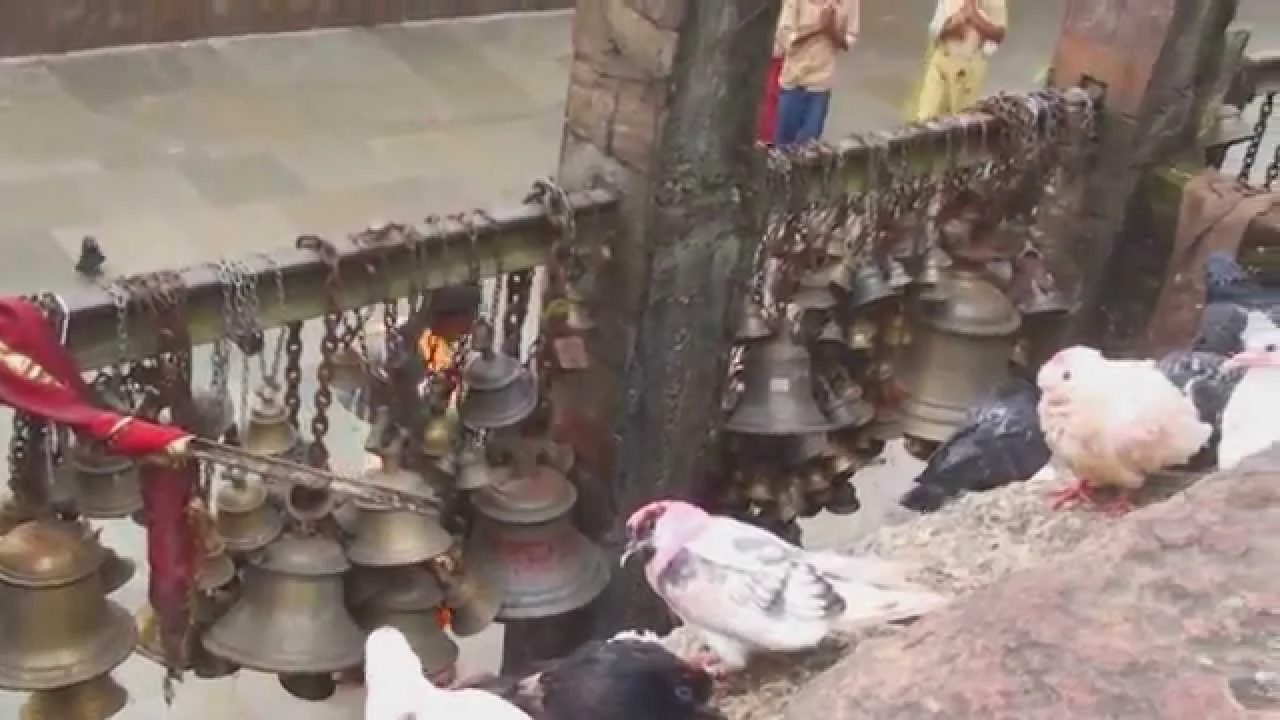
Kamakhya Devi is the goddess of the Kamakhya Temple on Nilachal Hill in Guwahati, Assam, one of the most sacred of the Shakti Peethas. She is Shakti as the source of creation itself. In her sanctum there is no idol: devotees worship a natural rock in the shape of a yoni, the womb, kept wet by an underground spring.
That single fact explains most of what people ask about her. Kamakhya is not worshipped as a figure with a face and arms but as the creative power that every face and form comes from. Below are her story, her temple, the festival that closes her doors for three days every June, and what she means to the people who climb Nilachal Hill to see her.
Watch: footage of Kamakhya Temple and Nilachal Hill, filmed by TD Film Studio in Guwahati.

Who is Kamakhya Devi?
Kamakhya is a form of the Great Goddess, Mahadevi, worshipped in the Shakta tradition as the giver of desire and its fulfilment. Her name is usually read as “the goddess whose name is desire” or “she who grants wishes”: kama means desire, and the whole region around her hill was called Kamarupa, “the land where Kama regained his form”.
In the temple she is identified with Tripura Sundari, the most beautiful of the ten Mahavidyas, the ten wisdom goddesses of the Shakta tradition. The other Mahavidyas, among them Kali, Tara, Bhuvaneshwari and Chhinnamasta, have their own shrines around her on Nilachal Hill. That is why Kamakhya is often described as the meeting place of all the forms of the Devi.
The story of Kamakhya Devi: where Sati’s body fell
Kamakhya’s story begins with Sati, the first wife of Shiva and daughter of King Daksha.
Daksha held a great sacrifice and invited every god except his son-in-law. Sati went to her father’s sacrifice uninvited, and when Daksha insulted Shiva before the assembled gods, she gave up her body in her own yogic fire.
Shiva arrived and lifted her body. Carrying it, he began the Tandava, the dance of destruction, and the worlds began to shake. To end his grief and save creation, Vishnu released his Sudarshana Chakra, which divided Sati’s body. Wherever a part of her fell, the earth became holy: these are the Shakti Peethas, the seats of the Goddess, traditionally counted as 51.
According to the Kalika Purana, the text most closely tied to Kamakhya, Sati’s yoni fell on Nilachal Hill. That is why the sanctum holds no statue: the Goddess is present there as the source of birth itself.
The same text tells how Kama, the god of love, had been burned to ash by Shiva’s third eye and regained his body at this place. Kamarupa, the old name of this land, keeps that memory.
Watch: the Devi in her fiercest form. Maa Kali vs Raktabeej, TD Film Studio’s animated Mahakali movie from the Devi Mahatmya.

Kamakhya Devi Mandir: the temple on Nilachal Hill
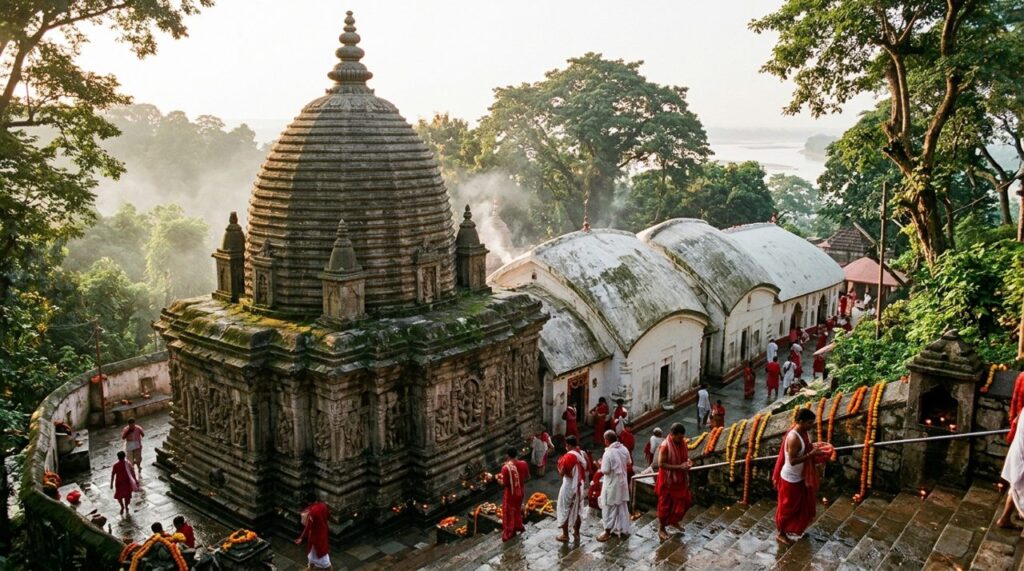
The Kamakhya Devi Mandir stands on Nilachal Hill in the western part of Guwahati, above the Brahmaputra. Local tradition credits its first temple to the legendary king Naraka of Pragjyotisha, the ancient kingdom of this land. The temple standing today was rebuilt in 1565, under the Koch king Naranarayana and his brother, the general Chilarai. The Ahom kings later added to it and endowed it.
Its shape is unlike temples elsewhere in India. Historians call it the Nilachal style: a beehive-like dome rising over a cruciform base, with sculpted panels set into the walls. From the outer halls, steps lead down into the garbhagriha, a dark, cave-like chamber. There, in the stone floor, is the yoni-shaped rock, covered in red cloth and flowers and wet from the spring beneath it.
Is there a murti (idol) of Kamakhya Devi?
Not in the sanctum. This is why searches for a “Kamakhya Devi photo” or “Kamakhya Devi murti” often find pictures of a decorated metal image of the goddess carried in festivals, or a painted form, rather than the sanctum. The sanctum itself is the stone and the spring. Photography inside it is not permitted.
Ambubachi Mela: why the temple closes for three days
Every year in June, during the monsoon month of Ahaar (Asadha), the temple closes for three days for the Ambubachi Mela. Devotees believe that in these days the Goddess, like the earth itself in the rains, goes through her annual cycle of menstruation. No worship is offered, farming pauses in many Assamese villages, and on the fourth day the doors reopen to enormous crowds.
The blessing most sought at Ambubachi is a piece of red cloth from the sanctum, the angabastra, which devotees keep as protection.
Ambubachi is one of the largest religious gatherings in eastern India. Pilgrims, householders and ascetics from across the country camp on the hill. The exact dates follow the calendar each year, so check the temple trust’s announcements before planning a visit.
Kamakhya’s other great festivals include Durga Puja and the spring Vasanti Puja. In those weeks the hill fills with the sound of drums and conch shells.
Why Kamakhya Devi is worshipped
Kamakhya is worshipped for three reasons, which together explain why she draws people from every part of India and beyond.
- She is the source. Most temples honour the Goddess in a form. Kamakhya honours the power that creates all forms. Worshipping her is worshipping life, fertility and creation at their root.
- She fulfils sincere wishes. Families come to pray for children, for marriages, for health and for courage in hard times. The name Kamakhya promises that desire, offered to the Goddess, can be fulfilled.
- She is the heart of the Shakta tradition. Kamakhya has been one of India’s great centres of tantric and Shakta practice for more than a thousand years. Here the Goddess is the highest reality, not a consort.
For the people of Assam she is also something simpler: the mother on the hill, visible from much of Guwahati, whose blessing is sought before weddings, exams, journeys and new beginnings.
Kamakhya Devi mantra
Devotees chant many mantras to Kamakhya. A widely recited short prayer is “Om Kamakhyayai Namah” (“salutations to Kamakhya”). It is chanted with a calm mind, and many devotees repeat it 108 times on a mala.
Visiting Kamakhya Devi for darshan
Kamakhya Temple is about 8 km from central Guwahati and is reached by road up Nilachal Hill. The queue for darshan of the sanctum can take many hours, especially on festival days. The temple trust offers special darshan tickets, and its official site publishes the current timings and rules. Dress modestly, carry as little as possible, and expect to descend into the sanctum barefoot over wet stone.
About the films on this page
TD Film Studio is a film and animation studio based in Guwahati, a few kilometres from Nilachal Hill. We make animated devotional films that tell India’s sacred stories as cinema, from Maa Kali vs Raktabeej and Jai Maa Kali to Shri Krishna’s Entire Life and Lord Shiva Story.
- See all our animated devotional films
- Subscribe to TD Film Studio on YouTube
- Planning a devotional film for your temple, trust or festival? Start a project
Frequently asked questions
What is the story of Kamakhya Devi?
When Sati gave up her body at Daksha’s sacrifice, Shiva carried it in grief until Vishnu’s Sudarshana Chakra divided it. According to the Kalika Purana, her yoni fell on Nilachal Hill in Guwahati, which became the Kamakhya Shakti Peetha.
Why is there no idol in the Kamakhya Devi temple?
The Goddess is worshipped as a natural yoni-shaped rock, kept wet by an underground spring, in a cave-like sanctum. She is honoured as the source of creation rather than in a sculpted form.
Why does Kamakhya Temple close during Ambubachi?
For three days each June, devotees believe the Goddess goes through her annual menstruation, as the earth does in the monsoon. The temple reopens on the fourth day for the Ambubachi Mela.
What does “Jai Maa Kamakhya” mean?
It means “Victory to Mother Kamakhya”. It is the greeting and prayer devotees call out on Nilachal Hill.
Where is Kamakhya Devi temple?
On Nilachal Hill in the west of Guwahati, Assam, India, above the Brahmaputra river.
Sources: the Kalika Purana; the Kamakhya Temple trust (maakamakhya.org); Kamakhya Temple and Ambubachi Mela on Wikipedia.