Revealed: Assamese Regional Cinema Audience Analysis 2025 – Top Reasons for Low Growth & 8X Market Potential
Executive Summary of Assamese Regional Cinema Audience Analysis
Assamese cinema, despite a rich cultural heritage and strong linguistic identity, currently reaches only a fraction of its potential audience. As of 2024, the market penetration stands at a low 2.4% among Assamese speakers—far below other major regional film industries like Malayalam, Telugu, Tamil, and Kannada. The biggest barrier is not audience disinterest or economic inaccessibility, but severe infrastructure deficits and an urban-rural access gap. With strategic interventions, Assam’s film industry could achieve up to 8x growth in regular viewership, transforming its market landscape.
Assam’s Demographics and Language Landscape
Total Population and Language Distribution in Assam
- Total Assam Population (2024): 36.16 million
- Assamese Language Speakers: 17.49 million (48.4% of total population)
- Urban Population: 5.10 million (14.1%)
- Rural Population: 31.06 million (85.9%)
This demographic split is crucial, as the overwhelming majority of the target audience lives in rural areas, where cinema access remains limited.
Urban vs Rural Population Breakdown
With nearly 86% of Assam’s population residing in rural areas, accessibility to cinema halls is a massive challenge and a defining feature of Assamese cinema’s market potential.
Economic Context: Income, Ticket Prices & Affordability
- Per Capita Income (2024): ₹154,222 annually (₹12,852 monthly)
- Weighted Average Ticket Price: ₹107
- Ticket Cost as % of Monthly Income: 0.8% (making it economically accessible)
Despite ticket prices being very affordable, this economic advantage does not translate into high cinema attendance, emphasizing that the main problem lies elsewhere.
Who Watches Assamese Cinema? Current Viewership Data
Current Market Penetration and Box Office Numbers
- Current Regular Film Audience: 422,735 (2.4% of Assamese speakers)
- Peak Performance: Bhaimon Da (2025) attracted 1,317,142 viewers (7.53% of Assamese speakers at peak)
- Top-Grossing Films:
- Bhaimon Da: ₹14.10 crores
- Sri Raghupati: ₹13.81 crores
- Bidurbhai: ₹10.11 crores
- Annual Assamese Box Office: ₹15-20 crores
Age-wise Audience Engagement
| Age Group | Penetration Rate | Viewers |
|---|---|---|
| 15-24 years | 4.0% | 125,954 |
| 25-34 years | 3.5% | 107,149 |
| 35-44 years | 2.5% | 65,601 |
| 45-54 years | 1.5% | 31,488 |
| 55-64 years | 0.8% | 9,096 |
Urban vs Rural Engagement Rates
- Urban Assamese Speakers: 2.47 million
- Urban Viewership Rate: 8.0% (197,329 viewers)
- Rural Assamese Speakers: 15.03 million
- Rural Viewership Rate: 1.5% (225,406 viewers)
Urban areas show 5x higher engagement rates due to better access to cinema halls.
- Rural Viewership Rate: 1.5% (225,406 viewers)
Assamese Cinema Infrastructure: The Critical Bottleneck
Cinema Hall Distribution Across Assam
- Total Cinema Halls: 80 across Assam
- Screens per Lakh Population: 0.22 (national average: 1.2)
- Infrastructure Adequacy: Only 18% of the national standard.
Urban vs Rural Access to Screens
- Guwahati/Dispur: 39 cinema halls (49% of the state’s screens)
- Rest of Assam: 41 cinema halls for 31 million people
- Districts Without Adequate Coverage: Most rural and semi-urban areas
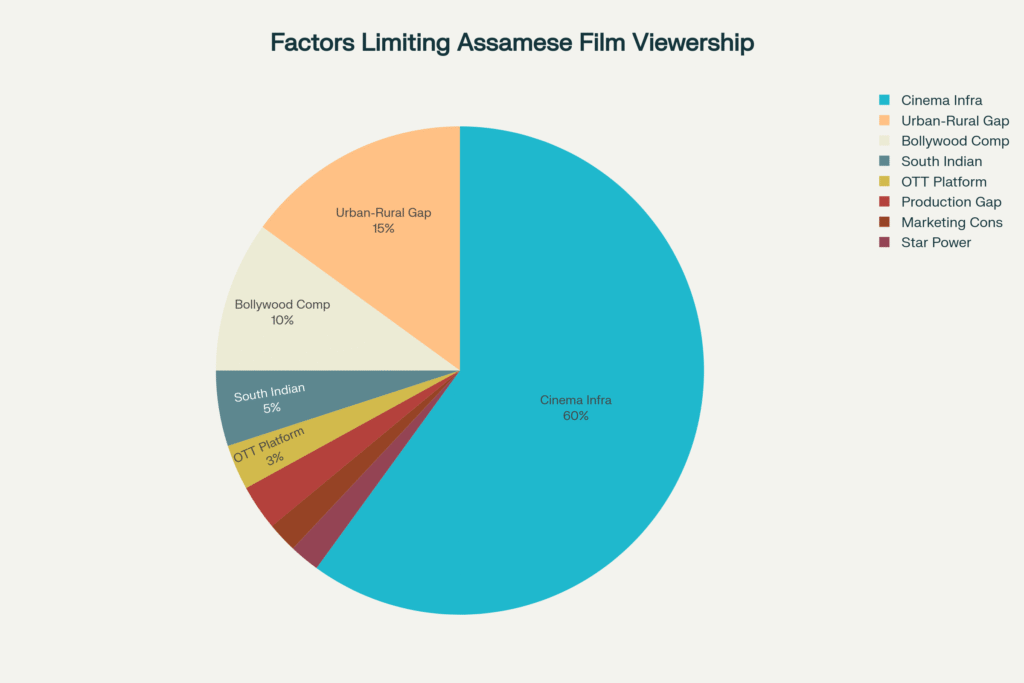
The 8 Primary Barriers to Assamese Cinema Growth
Detailed Analysis: Cinema Infrastructure, Urban-Rural Gap, Bollywood & Others
According to the pie chart on page 3, the barriers are:
- Cinema Infrastructure: 60% impact – severe shortage of screens
- Urban-Rural Access Gap: 15% impact – limited rural connectivity
- Competition from Bollywood: 10% impact – Hindi film dominance
- Other Factors (15%): South Indian film competition, OTT platform shift, production quality gaps, marketing constraints, limited star power.
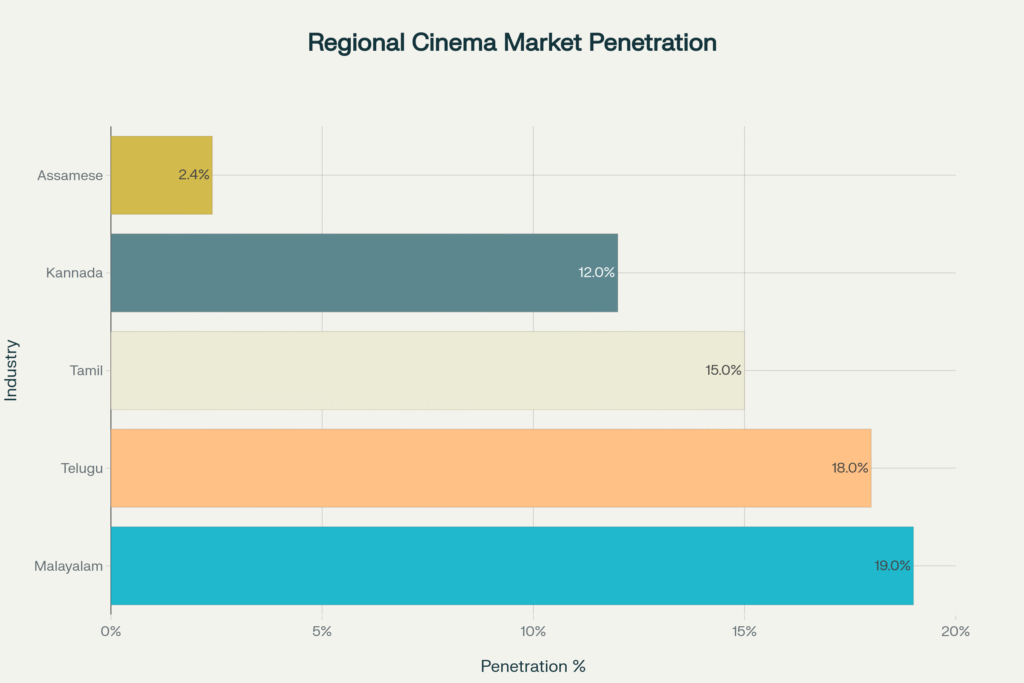
Regional Comparison: How Assamese Cinema Compares to Other States
Market Penetration: Malayalam, Telugu, Tamil, Kannada vs Assamese
The bar chart on page 4 highlights:
- Malayalam Cinema: 19%
- Telugu Cinema: 18%
- Tamil Cinema: 15%
- Kannada Cinema: 12%
- Assamese Cinema: 2.4%
Assamese cinema achieves only 12.6% of Malayalam’s penetration, signaling massive untapped potential.
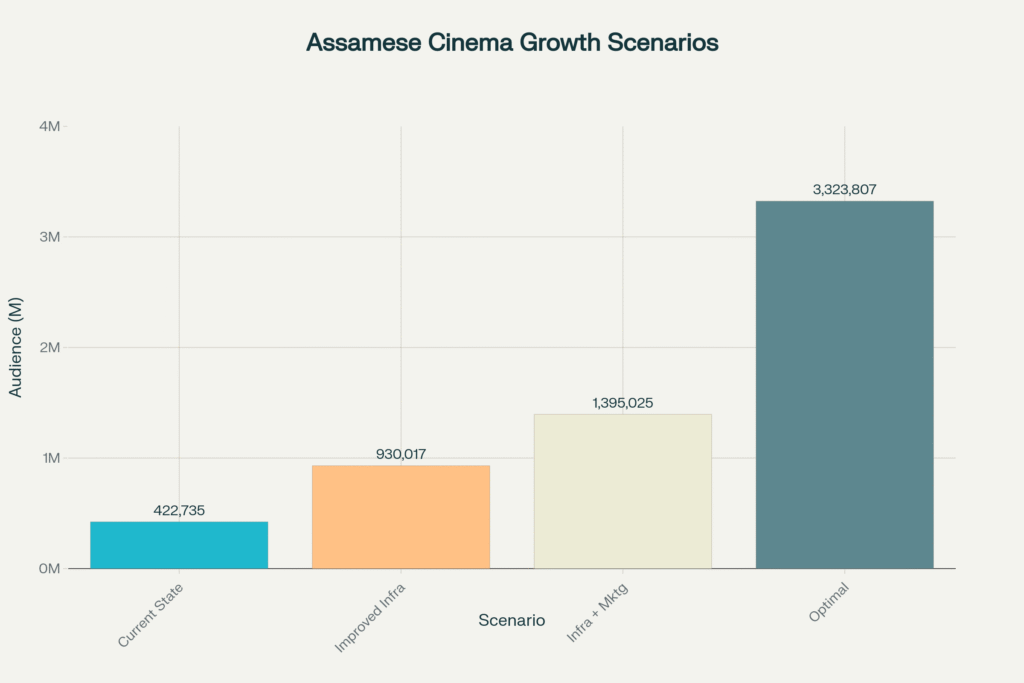
Growth Scenarios: What’s Possible for Assamese Cinema?
Scenario Analysis: Audience Growth Potential
Based on page 5’s chart and data:
- Current State: 422,735 viewers (2.4% penetration)
- Improved Infrastructure: 930,017 viewers (5.3% penetration)
- Infrastructure + Enhanced Marketing: 1,395,025 viewers (8.0% penetration)
- Optimal Scenario (Malayalam Benchmark): 3,323,807 viewers (19% penetration)
With adequate infrastructure and marketing, Assamese cinema could grow 8x, reaching over 3.3 million regular viewers.
Realistic Market Sizing: Urban vs Rural Prospects
- Urban: 197,329 viewers (47%)
- Rural: 225,406 viewers (53%)
Key Factors Behind Low Engagement: Deep Dive
Infrastructure Crisis
- Screen Density: Assam has just 80 screens for 36 million people, among the lowest in India.
- Limited Accessibility: 82% of the audience lacks reasonable access.
- Urban Concentration: Nearly half the screens are in Guwahati.
- Rural Exclusion: Most of the rural population remains underserved.
Cultural & Economic Factors
- Language Competition: Hindi and South Indian dubbed films dominate available screens.
- Content Quality Perceptions: Lower production budgets hurt film quality perceptions.
- Marketing Limitations: Assamese films have less promotional reach than Bollywood.
Marketing & Content Quality
- Production Budget Constraints: Affect production values.
- OTT Platform Competition: Growing but still secondary to infrastructure and screen access issues.
Lessons from Successful Regional Film Industries
Kerala’s Cinema Model: Infrastructure, Content, Distribution
- Screen Density: Kerala has 3x more screens per capita than Assam.
- Content Investment: Higher budgets deliver better production values.
- Distribution: More efficient marketing and OTT distribution systems.
Data Sources, Methodology, and Calculation Approach
- Population Data: 2011 Census, government projections to 2024
- Language Distribution: Linguistic survey data
- Box Office: Actual collections from recent successful films
- Infrastructure: State film corporation and industry reports
- Income Data: Government statistics
- Calculations: Market penetration, audience sizing, and benchmarking against other states
Actionable Recommendations for Assamese Cinema Growth
- Infrastructure Development: Expand from 80 to 200+ cinema halls for 5% penetration.
- Rural Focus: Mobile cinemas and rural screening programs.
- Content Investment: Larger production budgets.
- OTT Platforms: Dedicated Assamese content streaming.
- Government Support: Subsidies and tax incentives.
FAQs: Assamese Regional Cinema Audience Analysis 2025
1. Why is Assamese cinema’s market penetration so low?
The main barrier is a severe shortage of cinema halls, especially outside Guwahati. Urban-rural access gaps and the dominance of Hindi films on available screens also play a role.
2. Can Assam’s film industry grow significantly?
Yes, with better infrastructure, targeted marketing, and more OTT options, Assamese cinema could achieve 8x audience growth, reaching up to 3.3 million viewers.
3. Are ticket prices too high for most people in Assam?
No. Average ticket prices are less than 1% of monthly income, so affordability isn’t a key constraint.
4. Which age groups are most engaged with Assamese cinema?
Younger audiences (15–34 years) have the highest engagement, but overall penetration is low in all age groups.
5. How does Assamese cinema compare to other Indian regional film industries?
Assamese cinema lags far behind Malayalam, Telugu, Tamil, and Kannada industries, with only 2.4% market penetration.
6. What is the single most important solution?
Rapid infrastructure expansion—especially more rural screens—is the single biggest lever for audience growth.
Conclusion: Unleashing Assamese Cinema’s True Potential
The Assamese Regional Cinema Audience Analysis 2025 clearly reveals that Assamese cinema’s main constraint is not cultural or economic, but a lack of infrastructure and rural access. With bold, targeted interventions—expanding screens, investing in better content, improving distribution, and leveraging government support—the industry can transform from a marginal player to a thriving regional powerhouse. The time for action is now, and the data shows that with the right steps, Assamese cinema can truly capture the hearts and screens of millions more.
External Resource:
For more in-depth analysis of India’s regional film markets, visit FICCI Frames Report.