Introduction:
Spiritual art is a journey, an initiation into a realm where creativity and divinity converge. This exploration into the world of spiritual art began for me with a conversation that felt more like a sacred summons. Here in my studio in Guwahati, Assam, a space typically filled with the familiar hum of rendering fans and the soft glow of monitors, the voice of Sreenivasa Rao Challa—Prabhuji, as he is rightly known—came through, carrying with it an energy that was at once ancient and urgently present. He introduced me to a Krishna mantra, a mantra samputi as he called it, a divine composition of extraordinary power. As he chanted it,
“क्रिष्णक्रिष्ण क्रिष्णाक्रिष्णा|
क्रिष्णक्रिष्ण क्रिष्णाक्रिष्णा|
क्रिष्ण–ओम
क्रिष्ण–नमो
क्रिष्ण–भगवते
श्री–क्रिष्ण–वासुदेवाय| ।”,
the vibrations seemed to ripple through the very air in my studio, altering the quality of the light, charging the atmosphere with a palpable sense of the sacred. It was more than a sequence of words; it was a key, a spiritual technology designed to unlock something deep within the listener. And then came the request, the honor, the immense and terrifying responsibility: to give this sacred sound a visual form—to create a piece of transcendent spiritual art.
To be asked to create a visual accompaniment for such a sacred tool is not a task one takes lightly. It is an invitation to step into a current of immense spiritual force, a current that has flowed from the Dwapara Yuga through the tragic history of Chhatrapati Sambhaji, and into the present day as a prayer to heal a wounded planet. As an animator and a storyteller, my life’s work is to translate ideas into images, emotions into motion. But this was different. This was not about illustrating a story, but about creating a vessel—a visual sanctuary where a divine energy could reside and be experienced by a world largely deaf to its own spiritual heartbeat.
This article is an attempt to articulate the creative journey that began with that call. It is a chronicle of my perspective as the artist entrusted with this duty, an exploration of the profound purpose that drives this project, and a candid confrontation with the perils and ethical dilemmas that arise when one attempts to wield the tools of modern media to channel the timeless and the sacred.
The Path of Spiritual Art: The Artist as a Channel, Not a Scholar
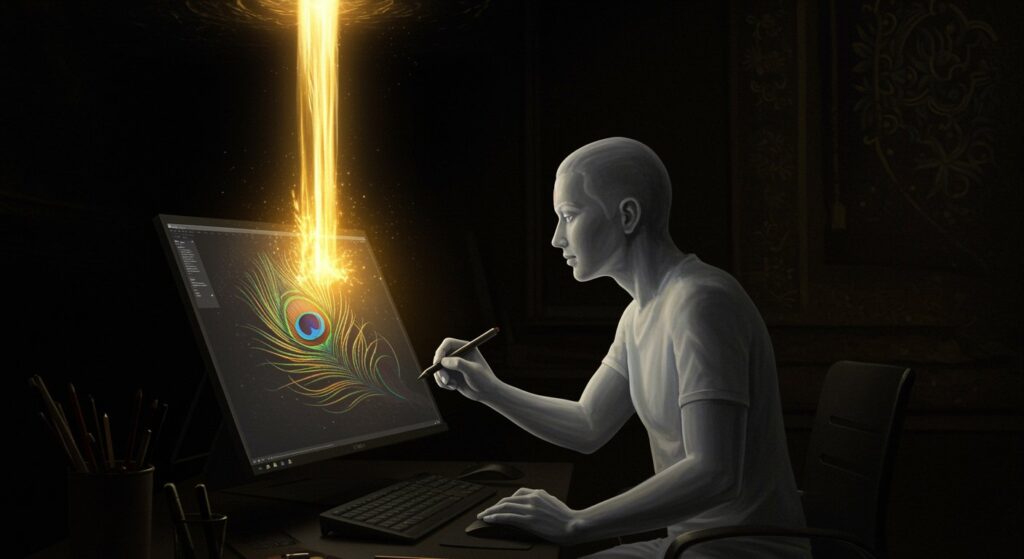
On this path of creating spiritual art, it was crucial to define my role with absolute clarity. “I am no carrier of life knowledge,” I explained to Prabhuji. In a culture that rightfully venerates its scholars and pandits, this might sound like an admission of inadequacy. It is not. It is a statement of purpose, a necessary delineation of paths. In a world drowning in information yet starved of wisdom, understanding the specific nature of one’s dharma, one’s role in the grand ecosystem of knowledge, is paramount. My purpose is not to be a walking encyclopedia of the scriptures. When Prabhuji asked me about the wife of Abhimanyu, I readily consulted an online knowledge base to find the answer: Uttara. This act, for me, is not a sign of ignorance, but a symbol of the modern creative process.
The creator of spiritual art today, especially in the digital realm, is a channel, a synthesizer. We live in an age where, by God’s grace, we have access to the accumulated knowledge of mankind at our fingertips. This technology, I believe, is not a soullous machine; it is a divinely enabled tool. My role is not to internalize and carry all of this information within my limited human memory. To attempt to do so would be to divert my energy from my true calling. My sadhana, my creative process as spiritual practice, is the art itself. My purpose is to channel all my creative energy, my intuition, and my understanding—all detailed on my TD Film Studio blog—into one singular focus: the betterment of the visual expression that I am trying to achieve.
This is a different path to wisdom, one that is deeply embedded within the traditions of Sanatana Dharma. It is the path of the bhakti and karma yogi, and specifically that of the shilpi—the sacred artisan. In the Indian aesthetic tradition, the act of creation is a form of yoga. The knowledge I gather from scriptures, from conversations with spiritual guides, and from my own research is the fuel. But it is the act of creation that transmutes this information into rasa, into felt aesthetic experience. My understanding of the divine leelas of Krishna deepens not by reading about them a hundred times, but by struggling for days to capture the precise expression on his face as he lifts the Govardhana Giri. This is the philosophy of art and devotion that guides every piece of spiritual art at TD Film Studio.
The Transformative Purpose of Spiritual Art
This work would be meaningless if its only goal were to create a pretty video to accompany a chant. The purpose, as I see it, is far more ambitious and infinitely more urgent. It is to engineer a moment of transformation, to create a “spark” of goodness so potent that it can become “contaminating” in a world saturated with the virus of negativity.
We are living in an age of profound spiritual blindness. People perform rituals out of habit, tradition, or social pressure, with little connection to the underlying meaning. I shared an example with Prabhuji that I see all too often: the wealthy man who believes he can wash away a lifetime of sins accumulated through corrupt means by simply walking into a temple and donating crores of rupees. For him, salvation is a transaction. He has performed the act, ticked the box, and feels his slate is clean. This transactional approach misses the entire point of dharma, which is about inner transformation, not external absolution.
It is this “blind” majority that I want to reach. Not the already devout who will find solace in any representation of the divine, but the cynical, the distracted, the broken, and the lost. These are the people who will not be moved by a simple slideshow of deities. They have seen thousands of such images on calendars and social media feeds. To them, it is just more religious iconography, easily dismissed and scrolled past. They need something more. They need a story. They need to be shown, not told. They need to feel.
This is where the true creative challenge lies. My objective is to transform the abstract power of Krishna mantra into a tangible, relatable visual narrative. When Prabhuji spoke of the mantra’s power to remove enemies, my mind didn’t jump to images of divine warfare. Instead, an idea sparked, an image of two opposing armies, their soldiers hardened and heartless, just following orders, killing each other in a pointless war. And in the midst of this carnage, a single innocent child, who cares nothing for their conflict, hands a flower to one of the soldiers. That pure, unconditional act of love, amplified by the vibrational power of the mantra playing in the background, becomes a catalyst. The soldier’s gun, in his very own hands, transforms into a shower of petals. The shock, the surprise, the dawning realization on his face—that is the story. The realization that the same hands that held a weapon of death are also capable of holding a thing of beauty. This is not a miracle performed by an external god; it is the awakening of the divine potential within a human being.
This is the kind of storytelling that I believe is necessary. We must “open that window in their mind which was closed.” We cannot force them to walk the path, but we can lead them to the window and perhaps even help them unlatch it. The great sage Bharata Muni, in the Natya Shastra, explained that the purpose of performance art is to evoke rasa, a state of elevated consciousness in the audience. The story of the soldier is designed to evoke Karuna Rasa (compassion) and ultimately Shanta Rasa (peace).
In this process, the music is the river, the very current of Nada Brahma, the universe as divine sound. And the visuals are the boat that carries the viewer along its current. I spent a great deal of time exploring musical forms for the mantra, long before the details of this endeavor were even formalized. I knew that the composition had to have a certain flow, like the waves of an ocean, to lead the listener into a meditative state. After many rounds of experimentation, I found a tune, a composition, that “echoed, quite resonated with me.” It was an instinctive feeling, a sense of rightness. This is the audio foundation upon which the visual journey must be built. The animation must move in perfect synergy with the music’s rhythm, its crescendos and its moments of quiet reflection. It is this holistic combination of sound, story, and image that can create an experience powerful enough to pierce the armor of modern cynicism and plant a seed of mantra meaning and transformation in the viewer’s heart.

The Peril of Spiritual Art: Confronting the Modern Asura’s Shadow
With great power comes great responsibility, and with a spiritual endeavor of this magnitude comes profound peril. As the creator tasked with giving form to this power, I would be remiss—and deeply irresponsible—if I did not confront the darker possibilities head-on. My conversations with Prabhuji were not just about purpose and praise; they were also a space for me to voice my deepest concerns, the ethical shadows that loom over this sacred work.
The Modern Asura Pattern: A Living Mythology
As I delved deeper into the stories of the Puranas, a disturbing pattern began to emerge, a pattern I saw reflected with chilling accuracy in the world around me. I spoke to Prabhuji about the Asuras—beings like Hiranyakashipu or Ravana who perform extreme penance (tapas), dedicate themselves with single-minded focus, and acquire immense boons and powers from the gods. They are often brilliant, disciplined, and incredibly charismatic. Yet, the moment they achieve this power, they become consumed by it. Their ego, inflated by their achievements, grows monstrous. They become haughty, arrogant, tyrannical, and use their hard-won power for destruction, oppression, and self-aggrandizement.
Then I looked at our modern world. I see this Asuric archetype everywhere. I see it in the corporate titans who build vast empires through ruthless ambition, sacrificing ethical considerations and human well-being for profit and market dominance. I see it in the political demagogues who master the art of rhetoric to amass power, only to use it to divide, control, and oppress. I see it in the tech visionaries who create world-changing technologies but become blind to the societal fragmentation and mental health crises their creations unleash. These figures exhibit a kind of fanatical dedication, a modern form of tapas, sacrificing everything at the altar of their ambition. And when they reach the pinnacle of success, possessing extreme wealth and influence, what happens? They become arrogant. They believe they are superior, that the rules no longer apply to them, that they can do anything they want. Prabhuji’s own story of the politician Dhanam Nagendra is a perfect, real-world example of this archetype. This is not a mere mythological trope; it is a recurring pattern of the human ego.
This realization is profoundly unsettling for a creative. It means that the very qualities of dedication and focused effort can, without the right consciousness, lead to a dark and destructive outcome. It forces me to question the nature of power itself and to be hyper-aware of the motivations behind my own creative drive. The danger is that one can become so focused on the creation of a powerful thing that one loses sight of the consciousness required to wield it. This understanding necessitates a constant state of self-reflection and humility. It informs the visual narrative by compelling me to focus not on the spectacle of power, but on the quality of the heart that wields it—the purity of Prahlada over the arrogance of Hiranyakashipu, the service of Hanuman over the ego of Ravana.
The Weaponization of the Sacred: A Creator’s Greatest Fear
My second, and perhaps greater, concern is the potential for the mantra itself to be misunderstood and misused. Prabhuji explained that the mantra has the power to “decimate, dissolve your enemies.” This is a potent and dangerous piece of information to release into a world steeped in transactional thinking. My fear, which I expressed to him directly, is what happens when the average modern person hears this. For many, I am certain their first thought will not be of spiritual purification, but of personal gain. “Oh,” they will think, “here is a tool I can use to destroy my business rivals, to defeat my political opponents, to harm the neighbor who filed a complaint against me.”
This is the path that perverted the pure science of Tantra, which was twisted by many into a tool for black magic and selfish manipulation. This is the path of the modern “wellness” industry, which often strips sacred practices of their context and commodifies them as “life hacks” for material success. The moment a sacred tool is viewed as a “magic bullet” for worldly problems, its spiritual essence is lost, and it becomes a weapon for the ego. This places an enormous ethical burden upon me as the visual storyteller. How do I present this power in a way that safeguards it from being weaponized? This question touches on the very ethics of sacred knowledge.
The answer lies in the very structure of the visual narrative. The story I create cannot simply be a depiction of an enemy being vanquished by a divine thunderbolt. That would reinforce the flawed, transactional understanding of the mantra. Instead, the visual story must be a lesson in spiritual science. It must explicitly show that the mantra’s first and primary action is internal. The transformation must begin within the chanter. The narrative must visualize the process of the mantra dissolving the chanter’s own feelings of animosity, hate, and fear first. The visual journey must therefore be one of self-purification. It might show dark, thorny vines of anger and resentment within a person’s heart being dissolved by the light of the chant, turning into soft, flowering creepers. Only after this internal purification can any external effect manifest, and that effect is most often one of peace and reconciliation, not destruction. The story must make it clear that you cannot wield the mantra against an “enemy” while your own heart is full of enmity. The visual narrative is my responsibility, my safeguard, and my ethical response to the peril of putting a sacred fire into the hands of a world that has forgotten how to handle it with reverence.
The challenge is immense, the responsibility is heavy, and the perils are real. But the purpose is a light that dispels all shadows. My commitment is to forge a visual dhun that is worthy of the sacred sound it serves—a boat sturdy enough to carry souls across the turbulent waters of the modern world to a shore of peace, transformation, and divine love. It is a humble offering at the feet of the Divine, a prayer made not of words, but of color, light, and motion.
Frequently Asked Questions (FAQ)
1. How can art be a form of yoga or spiritual practice?
Art becomes a form of yoga when the creative process itself is treated as a discipline for concentration, self-purification, and connection to a higher consciousness. Much like a yogi uses breath (pranayama) or postures (asana), an artist can use their craft—the focus required for a single brushstroke, the dedication to finishing a complex animation—to quiet the ego and become a channel for inspiration. This creative process as spiritual practice transforms art from mere self-expression into an act of devotion and service.
2. What is the true purpose of chanting mantras?
While mantras can have specific effects, their ultimate purpose is transformation. The vibrations of a mantra work to purify the chanter’s consciousness, dissolving negative patterns like anger, fear, and animosity. The power of a Krishna mantra, for example, lies not just in invoking a deity but in attuning the chanter to the divine qualities of love, joy, and universal harmony. The true goal is internal alignment, from which positive external changes naturally flow.
3. How can we avoid the misuse of spiritual knowledge today?
Avoiding the misuse of sacred knowledge requires a focus on context, intention, and self-purification. Instead of presenting spiritual tools as quick fixes for material problems, we must emphasize their primary role in inner work. The ethics of sacred knowledge demand that we teach that power without purity is dangerous. Any practice, whether it be a mantra or meditation, should begin with the intention of purifying oneself first, rather than trying to manipulate an external outcome.
4. What does the Asura pattern represent in the modern world?
The Asuric archetype represents a timeless pattern of the human ego. In today’s world, it manifests as the relentless pursuit of power, wealth, or fame without a corresponding development of wisdom, compassion, or ethical responsibility. It is the story of individuals who achieve great success through intense discipline but become arrogant and destructive, believing their power makes them superior. It serves as a cautionary tale about the importance of balancing ambition with humility and inner growth.